
Last updated on: February 27, 2026
30 Views
Yuvika Rathi
College Student
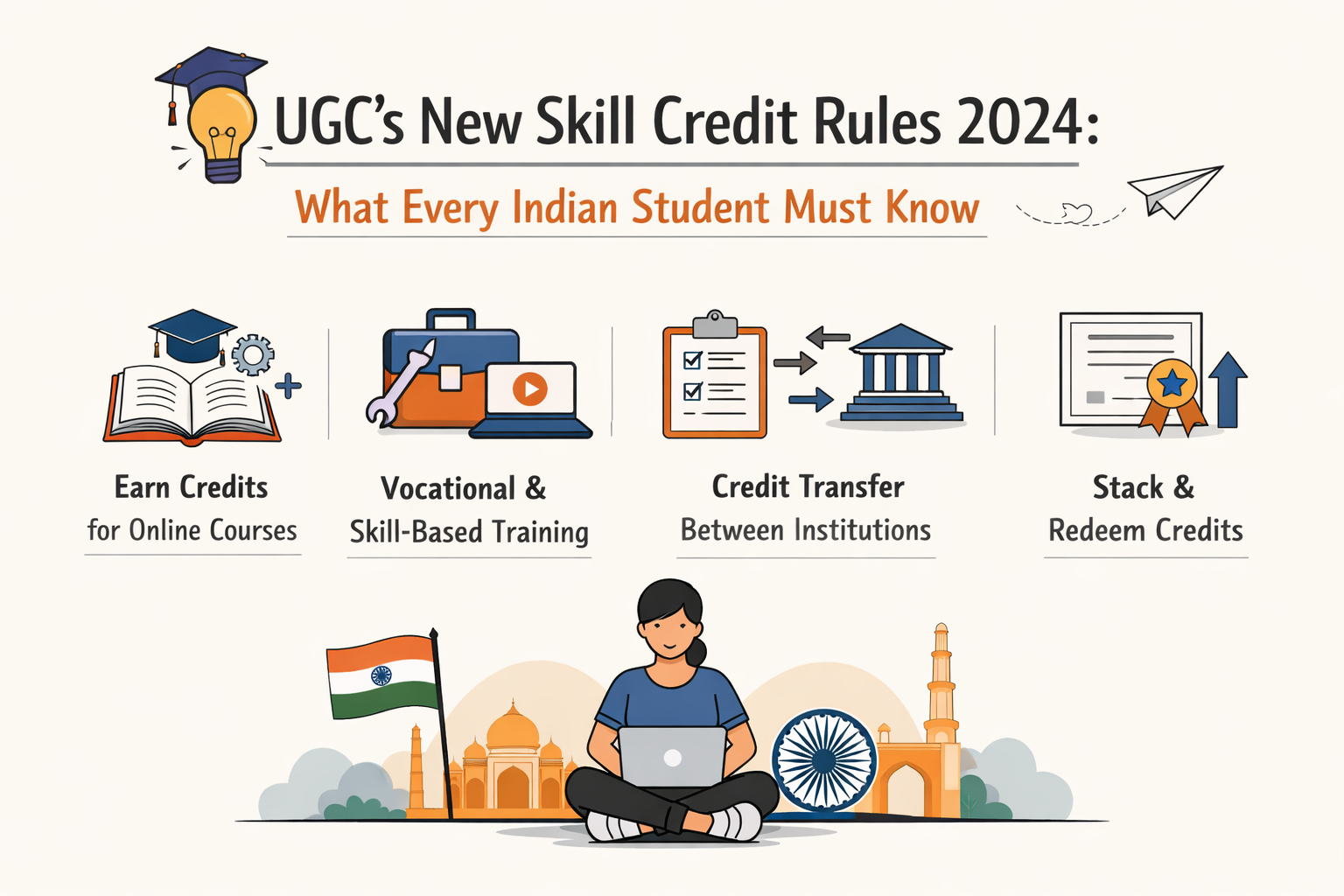
When the National Education Policy 2020 made headlines, the conversation centered on multiple exits, four-year degrees, and flexible curriculums. What slipped under the radar — quietly but consequentially — was UGC's overhauled Skill Credit Framework. It doesn't just add vocational courses to your degree. It fundamentally redefines what counts as learning, who can teach it, and how it gets recognized on your transcript.
If you're a student in India right now and you haven't looked into this, you're leaving real academic — and professional — value on the table.
Under the new UGC Curriculum and Credit Framework for Undergraduate Programmes (CCFUP), introduced in 2022 and actively being implemented through 2024, every undergraduate degree must now include a mandatory skill credit component. Here's the breakdown that matters:
A standard 4-year undergraduate program requires 160 credits total. Of these, a minimum of 20 credits must come from skill-based courses. That's 12.5% of your entire degree — not optional, not peripheral. Mandatory.
These skill credits fall into three distinct categories. Vocational and professional skills include courses like digital marketing, financial accounting software, coding, and supply chain management. Entrepreneurship and innovation credits cover startup fundamentals, design thinking, and business model development. Internship and hands-on credits recognize structured workplace learning — meaning a verified internship can now directly contribute to your degree completion.
Here's what almost no one in a standard college orientation session explains clearly: skill credits can be earned outside your university.
UGC's framework explicitly permits students to earn skill credits through SWAYAM — India's national online education platform — through recognized industry certifications, and through apprenticeships registered under the National Apprenticeship Promotion Scheme (NAPS). A Google Digital Marketing certificate, a NASSCOM-affiliated coding course, or an NSDC-recognized vocational program can all qualify — provided your institution has formally mapped them to their credit framework.
This means a student can strategically stack industry-relevant certifications while completing their degree, have them officially recognized on their transcript, and graduate with a credential that reflects both academic and professional competence simultaneously.
Employers in sectors like IT, BFSI, retail, and manufacturing have long complained that Indian graduates are academically qualified but professionally underprepared. The skill credit mandate is UGC's structural answer to that criticism.
For students, the implication is direct: two graduates with identical academic scores can now have meaningfully different transcripts based on the skill credits they chose to pursue. A B.Com student who used their 20 skill credits on financial modeling, GST compliance software, and a verified fintech internship looks categorically different to a recruiter than one who took the minimum-effort route through generic institutional skill courses.
The differentiation is now built into the degree itself — not just the resume.
Implementation remains inconsistent. Many universities have introduced skill credit courses on paper but haven't built the infrastructure to recognize externally earned credits. Students attempting to transfer SWAYAM course completions or industry certifications into their ABC accounts often find that their institution hasn't completed the mapping process.
The practical advice: don't assume your institution has done the work. Visit your academic office directly, ask for the official list of approved external skill credit sources, and get written confirmation before investing time in any external course expecting credit recognition.
Rahul, a third-year BBA student at a central university in Bhopal, realized early that his university accepted SWAYAM completions as skill credits. He completed three SWAYAM courses — Business Communication, Introduction to Python, and Entrepreneurship — earning 6 skill credits externally. Combined with a 4-credit verified internship at a local logistics firm, he covered 10 of his 20 required skill credits through experiences that simultaneously built his resume. He graduated with a transcript that told a story — not just a GPA.
UGC's skill credit rules are one of the most career-relevant changes in Indian higher education in years. They reward initiative, validate real-world learning, and create a framework where your degree can reflect who you actually are professionally — not just what you memorized for exams. The students who understand this system early will graduate ahead. The ones who don't will wonder why their equally-scored peers are getting more callbacks.