
Last updated on: February 27, 2026
35 Views
Yuvika Rathi
College Student
The Central Board of Secondary Education has made an important announcement for Class 12 students of 2026. The board has officially closed the marks verification facility after the declaration of the Class 12 board results. The new regulations prevent students from submitting rechecking or retotaling requests or evaluation requests for their answer sheets during this academic year.
For decades, students scoring unexpectedly low could apply for marks verification to catch totaling errors or unchecked answers. That safety net no longer exists for Class 12 2026 students. But the reason isn't arbitrary — it's structural. CBSE has shifted to an entirely digital evaluation system, and claims that eliminates the errors verification was designed to catch.
The decision has been made because CBSE introduced a new digital system to evaluate Class 12 answer sheets through on-screen marking. The board claims that the new system improves checking accuracy while reducing checking errors.
On-screen marking operates as a contemporary digital method where examiners check answers on computer screens rather than physical paper. All answer sheets are scanned and transformed into digital format. Examiners enter marks directly into the digital system. Digital systems process all calculations through computerized systems, which eliminates most calculation errors that typically occur when people manually evaluate paper documents.
The system changes lead CBSE to define final marks as correct because they make verification unnecessary. Students cannot request rechecking of marks. No re-evaluation will be done. The marks shown in the result will be treated as final.
Translation: CBSE is arguing that because computers handle totaling and no human touches physical mark sheets, there's nothing left to verify. The marks you see are the marks you get — permanently.
In 2025, CBSE changed the sequence of post-result services. Students could first obtain a photocopy of their evaluated answer book before deciding to apply for verification of marks, re-evaluation of questions, or both. The process required students to first apply for a photocopy of the answer sheet, review it, and then decide whether verification or re-evaluation was needed.
According to the changes made by CBSE in 2025, you were first required to apply for a photocopy of your answer book to proceed with other services. You could apply for verification after obtaining a photocopy of your evaluated answer book. You could also apply for revaluation services if you were not happy with the marks awarded to you.
But in 2026, that entire pathway has been shut for Class 12. The marks verification facility has been closed by CBSE for Class 12 Exam 2026 because the organization is moving to an entirely digital assessment framework. You cannot apply for photocopies. You cannot apply for verification. You cannot apply for re-evaluation.
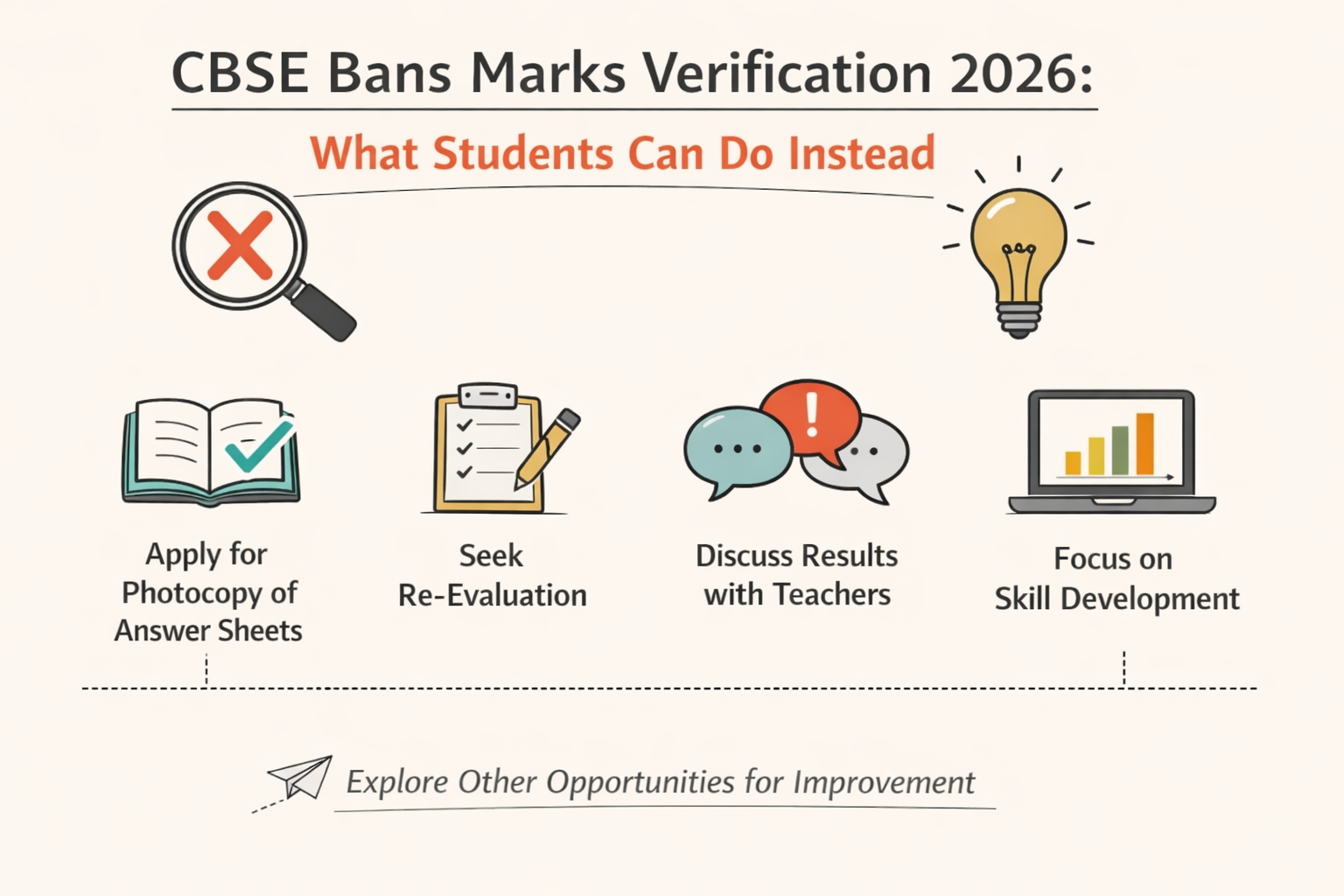
While verification is banned, students facing mark discrepancies aren't entirely without options. Here's what remains available:
Option 1: Apply for Answer Sheet Photocopy (If Available) Check the official CBSE portal after results for any photocopy access window. While verification is closed, CBSE may still provide answer sheet photocopies for transparency. If available, apply immediately. Reviewing your answer sheet helps you understand what was marked wrong and prepare better for compartment exams or future attempts if needed.
Option 2: Compartment Exam Route If you failed a subject or scored below passing marks, you can appear for CBSE compartment exams typically held in July-August. This is your direct second chance. Compartment exams follow the same syllabus and pattern. Passing the compartment exam updates your marksheet officially.
Option 3: Formal Grievance Through School If you genuinely believe there's a systemic error — like an entire section of your answer sheet wasn't evaluated or marks for a question are mathematically impossible — file a formal written complaint through your school principal. CBSE's regional office may review extraordinary cases involving technical errors in scanning or mark entry.
Option 4: Re-Appear in 2027 as Private Candidate If your marks critically affect college admissions and you have time flexibility, consider appearing as a private candidate in CBSE 2027. Many students take this route when unhappy with scores, especially when applying abroad where every percentage point matters. You retain your current marks and improve selectively in chosen subjects.
CBSE's move eliminates recourse for students who genuinely had portions unchecked or suffered evaluator bias. Digital systems prevent totaling errors, but they don't prevent evaluator mistakes in awarding marks for subjective answers. An English literature answer or a business studies case study response still requires human judgment. If an evaluator misunderstood your answer or marked it harshly, you now have zero mechanism to challenge that assessment.
The re-evaluated marks principle applied in 2025 when re-evaluation was available stated that even if marks decreased after re-evaluation, the new lower marks would be accepted as final. But in 2026, there's no re-evaluation to even attempt. Your first evaluation is your only evaluation.
Students should accept the change and move forward confidently toward their next academic step. That's CBSE's official position. But the practical implication is students must prepare more meticulously during exams. There's no post-result safety net. Your answer writing strategy, presentation clarity, and adherence to marking schemes must be perfect the first time.
For students appearing in 2027 and beyond, this policy creates new exam pressure. Knowing that whatever marks the first evaluator assigns are final and irreversible raises the stakes of every board exam answer significantly.
CBSE has closed marks verification for Class 12 2026 citing digital evaluation accuracy. While on-screen marking does eliminate calculation errors, it doesn't eliminate evaluator judgment errors in subjective questions. Students facing mark discrepancies have limited recourse: apply for answer sheet photocopies if available, use compartment exams for failed subjects, file formal grievances through schools for technical errors, or re-appear in 2027 as private candidates. The verification facility that helped thousands catch totaling mistakes is gone. What remains is the original evaluation — and students must trust that evaluators got it right the first time.