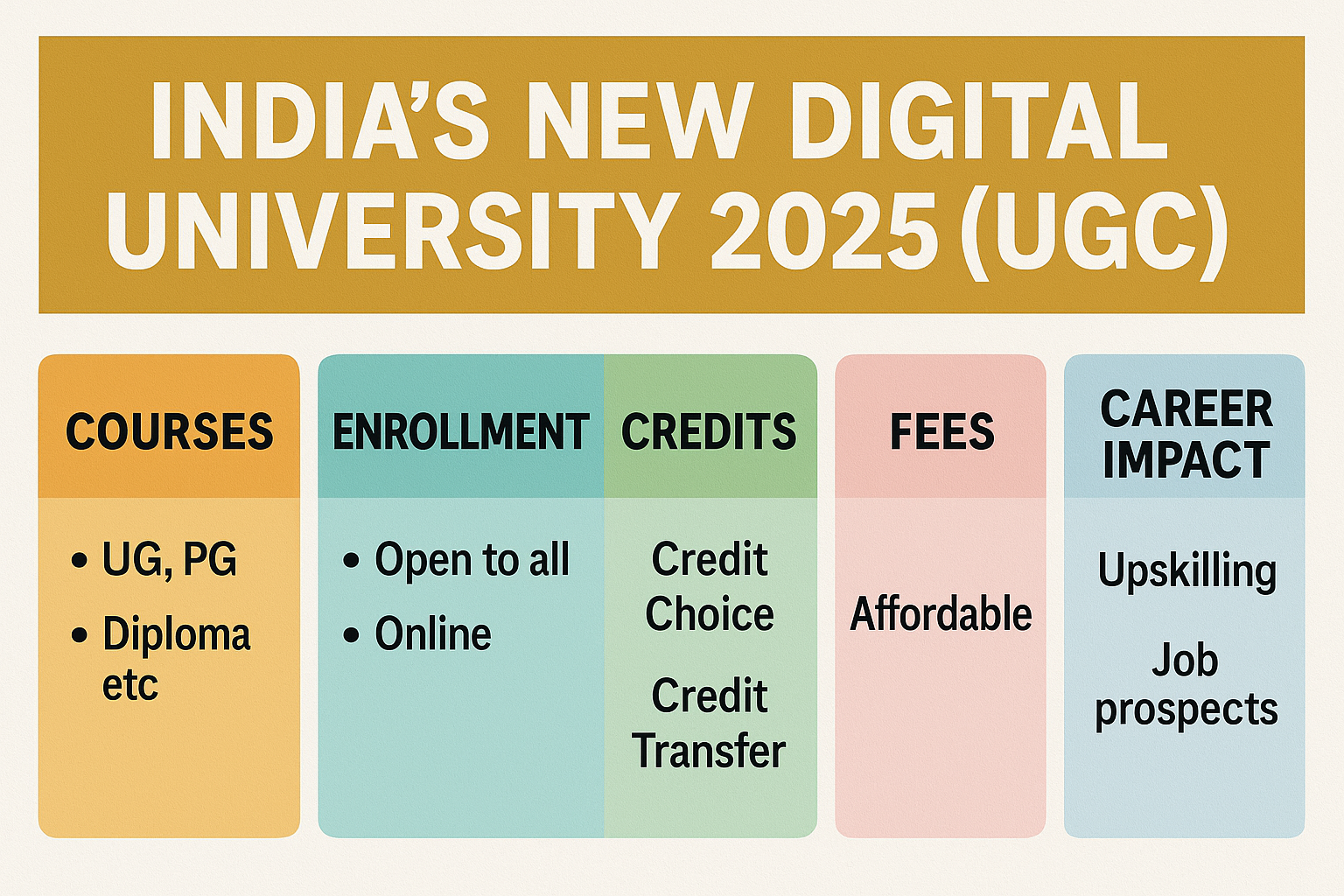
India’s New Digital University 2025: Everything You Need to Know
1. Introduction: What Is This “Digital University” Push?
In 2025, the University Grants Commission (UGC) significantly expanded its online and distance higher-education ecosystem. Through its Distance Education Bureau (DEB), UGC approved 101 universities for Open & Distance Learning (ODL) and 113 universities for fully online programs for the July–August 2025 session.
This move marks one of the biggest regulatory pushes in India to legitimize and scale digital higher education, making it more accessible, regulated, and standardized.
2. Why Did UGC Do This? (The Rationale)
- Access & Flexibility: By allowing more universities to run online and distance programs, UGC is democratizing higher education — especially for students in remote areas or those who cannot attend full-time, on-campus courses.
- Quality Assurance: Through strict criteria (credit hours, faculty qualifications, territorial jurisdiction, learner support centers), UGC ensures that online / ODL courses maintain a high standard.
- Regulation & Oversight: UGC’s creation of a structured admission system (DEB-ID) prevents fraudulent or unrecognized institutions from exploiting students.
- Cost Efficiency: Online programs can be more cost-effective, both for universities (lower infrastructure cost) and for students (no relocation, cheaper logistics).
3. Admission Process: How to Get In
3.1 DEB-ID: The Key Requirement
To enroll in any UGC-recognized ODL or online program, students must generate a DEB-ID:
- Register on the UGC-DEB portal: Distance Education Bureau | UGC
- Use your Academic Bank of Credit (ABC) ID to create the DEB-ID. dbuodl.in
- If you don’t yet have an ABC ID, you can set one up via DigiLocker. dbuodl.in
- Once created, your DEB-ID is lifetime valid. dbuodl.in
- No DEB-ID = No Admission in ODL / Online programs. dbuodl.in
3.2 Key Dates & Regulations
- Last date to apply for the 2025 ODL / online session: 15 October 2025.
- Universities must upload admission data on the DEB portal.
- HEIs must follow UGC’s regulations on territorial jurisdiction (for ODL), learner support centres, credit allotment, program duration, etc.
- For deemed universities: If they offer online / ODL courses in management, computer applications, or travel & tourism, they must obtain AICTE NOC.
4. Courses & Eligibility: What You Can Study
- Wide Variety: Universities are offering a broad spectrum of UG and PG programs — BAs, BCom, BCA, MAs, MSc, etc.
- Prohibited Subjects: From the 2025–26 session, healthcare & allied courses are banned in online / ODL modes. These include:
- Psychology
- Microbiology
- Biotechnology
- Clinical Nutrition / Dietetics / Food & Nutrition Science
- Other healthcare-allied courses
- Credit System: Programs must follow UGC’s credit-based framework (as per ODL regulations).
- Assessment Pattern: Example – Gujarat University’s online degree assessments are 30% internal + 70% external.
5. Fee Structure: How Much Will It Cost?
- Example – Gujarat University: For its 6 online programs (BA English, BCom, BCA, MA English, MCom, MSc Math), the fees range between ₹6,000 and ₹12,000. The Times of India
- These fees are relatively modest — partly because distance and online education avoids many on-campus costs.
- However, fees vary: depending on university, course type, and level. Always check the specific university website for the exact fee.
6. Comparing Online/ODL vs Offline University Education
| Dimension | Online / ODL (Digital University) | Offline (Traditional Campus) |
| Flexibility | Very high — study from anywhere, self-paced | Fixed schedule, on-campus attendance |
| Cost | Generally lower (less infrastructure / relocation cost) | Higher — accommodation, transport, campus fees |
| Admission Process | DEB-ID, ABC credit, regulated by UGC | Traditional admission, entrance tests / merit lists |
| Quality Assurance | Credit-based, regulated by UGC DEB; but variable experience | More consistent in-campus resources, labs, faculty |
| Practical / Lab Work | Limited — not ideal for hands-on / lab-heavy courses | Excellent for science, practical, experiential learning |
| Recognition | UGC-recognized, equivalent degrees (if DEB-entitled) | Widely accepted for jobs, further studies, research |
| Learning Style | Self-driven, requires discipline | Structured, peer-learning, in-person interaction |
Verdict: Online / ODL is great for flexibility, affordability, and access. But for courses requiring labs or practical work, traditional offline modes may still be the better choice.
7. Approved Universities: Choosing the Right One
- Always check the official UGC DEB list before applying. The list of HEIs recognized for ODL / online programs is on the DEB portal. Distance Education Bureau
- Look for:
- Course-specific recognition – Is that particular course approved by UGC?
- University credibility – NAAC grade, ranking, reputation.
- Learner Support Centres (for ODL) – These are physical centers to help distance learners.
- Fee Transparency – Official university site should have detailed fee structure.
- Credit Transfer Options – Can you use credits later via Academic Bank of Credit?
Example: Gujarat University is one of the approved institutions launching 6 online programs in 2025.
8. Career Impact: Is It Worth It?
Pros:
- Legitimate Degree: With UGC-DEB approval, online / ODL degrees are recognized and valid.
- Flexibility for Work / Life: Students can study while working or managing other commitments.
- Bridge to Further Education: You can accumulate credits (via ABC) and potentially move to on-campus or hybrid programs later.
- Cost Savings: Lower fees + no relocation = less financial stress.
- Scale of Reach: Universities can admit more students; capacity for growth.
Challenges:
- Limited for Practical Fields: For lab-based or clinical courses, online / ODL may not give the needed exposure.
- Self-Discipline Needed: Without classroom structure, students must be self-motivated.
- Employer Perception: Though improving, some traditional employers may still prefer campus degrees (varies by industry).
- Infrastructure Gaps: Internet access, study environment, and digital literacy can be barriers.
9. Risks & Cautions for Students
- Fake / Unrecognized Universities
- Verify on the UGC DEB portal whether a university is entitled for online / ODL.
- Be wary of universities advertising “online degrees” — check regulatory status.
- Wrong Course Mode
- Some courses are banned online / ODL (e.g., healthcare-allied) as per new UGC rules.
- Misleading Fee Claims
- Always confirm fees from the official university website, not just ads.
- Watch out for hidden costs like “support centre fees” or “exam centre fees.”
- Peer / Academic Isolation
- In online / distance learning, networking and peer learning may be limited compared to campus life.
10. How to Apply: Step-by-Step Guide
- Shortlist Universities
- Use the UGC-DEB list.
- Filter by course, fees, type (ODL / online), and recognition.
- Check Eligibility
- Confirm minimum qualification, credit framework, and course duration.
- Generate DEB-ID
- Go to UGC-DEB Student Portal dbuodl.in
- Use ABC ID (get one via DigiLocker if you don’t have it). dbuodl.in
- Apply to University
- Fill in their admission form. Upload documents (marksheets, ID, etc.).
- Pay Fees & Confirm Admission
- Use the university’s payment gateway. Keep proof of payment.
- Start Learning
- Once admitted, access course materials, attend lectures (live / recorded), and submit assignments.
11. Future Outlook: What’s Next for the Digital University Movement
- Scale & Growth: Expect more universities to join the DEB-entitled list in coming years, widening access.
- Credit Banking: The Academic Bank of Credit (ABC) system will become more central, allowing greater credit mobility.
- Hybrid Models: More blended degrees (part online, part in-person) could emerge, giving best of both worlds.
- Technology-Driven Quality: Use of AI, VR, and interactive platforms could improve engagement and learning outcomes.
- Regulatory Tightening: With more students, UGC/DEB will likely enforce stricter quality norms and audits for online / ODL programs.
12. Conclusion
India’s 2025 “Digital University” push is a transformative moment in higher education. By approving over 200 universities (combined ODL + online), UGC is democratizing education, making it more flexible, and ensuring regulated growth. For students, it’s a golden opportunity — but only if used wisely.
If you're thinking of enrolling:
- Confirm the university’s DEB-entitlement.
- Get your DEB-ID (with ABC).
- Compare fees and courses carefully.
- Think about your career goals: is online enough, or do you need a campus degree later?
Direct Useful Links
- UGC-DEB Portal (to check list & apply): https://deb.ugc.ac.in/
- DEB-ID Registration: https://deb.ugc.ac.in/StudentDeBID
- UGC DEB Notification (PDF) on 2025 Admissions: Distance Education Bureau
- DigiLocker (for ABC ID): https://www.digilocker.gov.in (needed for DEB-ID) dbuodl.in
- Gujarat University Online Courses Information: Search GU’s official website or news articles like this one: “GU begins registration … ₹6,000–₹12,000” The Times of India
