
Last updated on: February 27, 2026
444 Views
Yuvika Rathi
College Student
For decades, Indian students lived by one brutal rule: drop out of college before completing your degree, and you walk away with nothing. No credential. No recognition. No proof that you spent one, two, or three years acquiring knowledge. The National Education Policy (NEP) 2020 changed that — permanently.
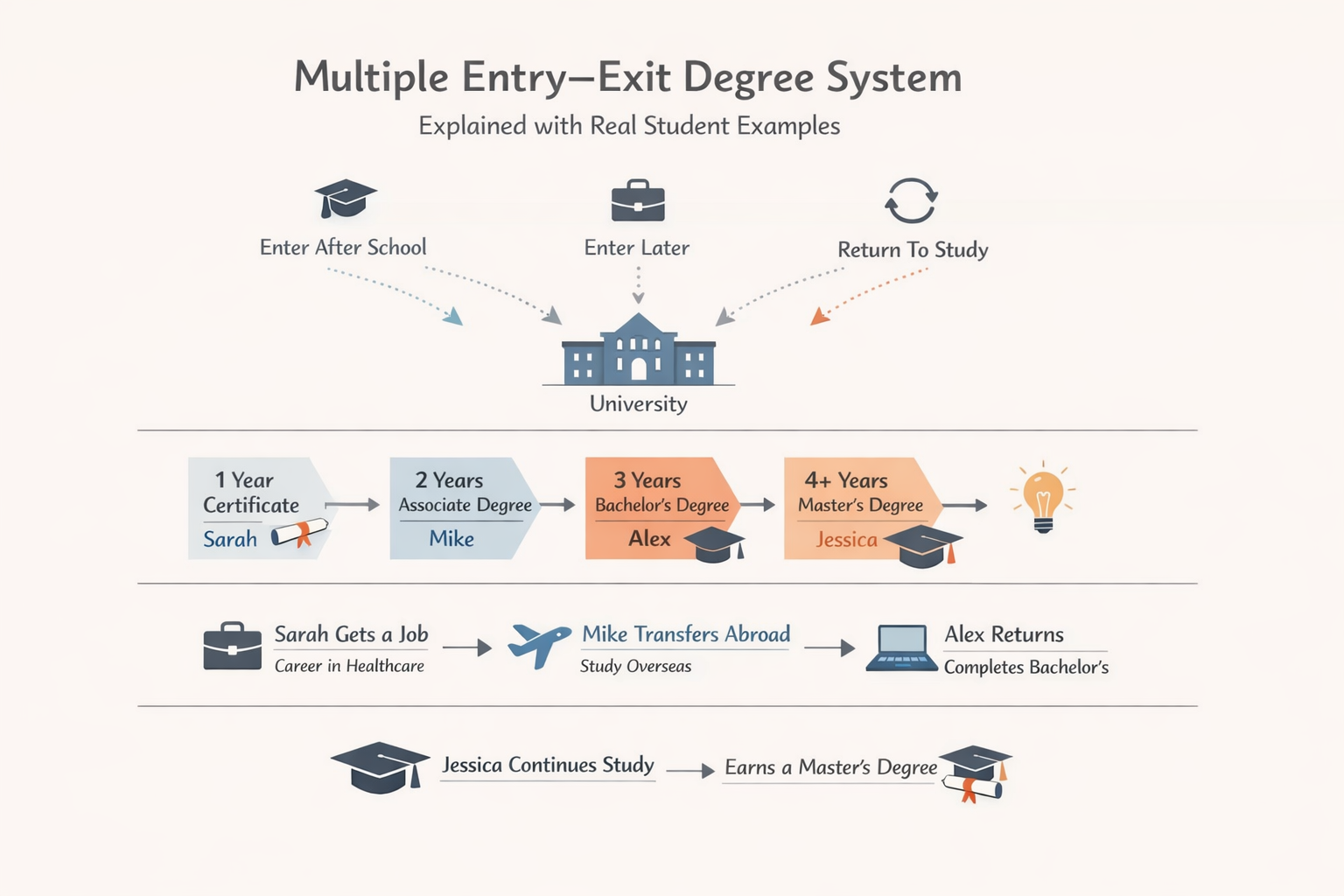
The Multiple Entry and Exit System (MEES) is now one of the most significant structural reforms in Indian higher education. It allows students to leave a degree program at different stages and still receive a formal academic credential for the time they invested. It also allows them to re-enter later and continue from where they left off.
Under the UGC framework aligned with NEP 2020, a standard undergraduate degree now has four recognized exit and entry points:
After Year 1 — Students who exit receive a Certificate in their chosen discipline. After Year 2 — Students receive a Diploma. After Year 3 — Students earn a Bachelor's Degree (the traditional standard). After Year 4 — Students complete a Bachelor's Degree with Research/Honours, which is the new premium qualification tier.
All credits earned are recorded in the Academic Bank of Credits (ABC), a digital repository managed by the government. This is the backbone of the system — it's what makes re-entry possible.
Scenario 1 — Riya, 19, Delhi Riya enrolled in a B.Com program but had to leave after Year 1 due to a family financial crisis. Under the old system, she'd have nothing to show for it. Under MEES, she exits with a Certificate in Commerce. Two years later, when her situation stabilizes, she re-enrolls — not from scratch, but from Year 2.
Scenario 2 — Arjun, 22, Pune Arjun completed two years of a B.Tech program before landing an apprenticeship at a German manufacturing firm. He exits with a Diploma in Engineering. The employer recognizes it as a valid credential. Arjun plans to return and finish his degree in the future.
Scenario 3 — Meera, 24, Chennai Meera always wanted to do research. She completes all four years and graduates with a B.Sc. with Research Honours in Biotechnology — a qualification that significantly strengthens her PhD application abroad.
The MEES isn't just academically progressive — it has real economic logic. India has one of the world's highest college dropout rates, largely driven by financial hardship, family obligations, and early employment opportunities. The old system punished all of these. The new one accommodates them without penalizing ambition.
For employers, it creates a more transparent credential landscape. A diploma-holder is no longer a "dropout" — they're someone with a verified, government-recognized qualification at a specific academic level.
Not all universities have fully adopted the system yet. Deemed universities and central universities are ahead, while many state universities are still in transition. Students must verify with their specific institution whether ABC registration and credit portability are functional before banking on these benefits.
The Multiple Entry–Exit System is India's most student-friendly academic reform in a generation. It rewards effort, accommodates life's unpredictability, and creates a credentialing ladder that works for real people — not just ideal circumstances.