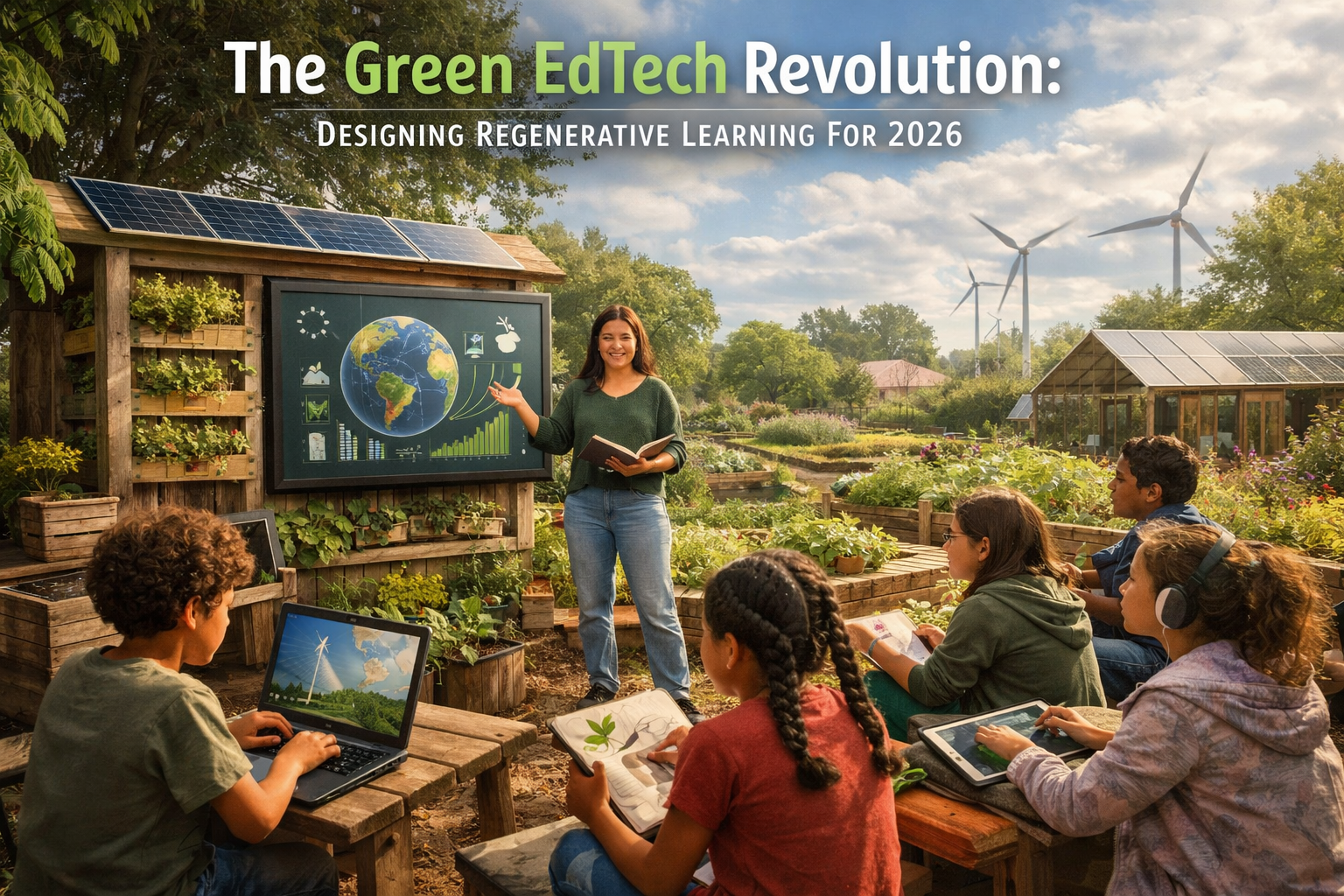
The conversation around "Green Education" has shifted. In 2024, it was about paperless classrooms; in 2026, it is about Regenerative Design and Digital Carbon Literacy. As global institutions race toward UNESCO’s 2030 carbon-neutral goals, educational materials are undergoing a radical transformation.
We are moving beyond "doing less harm" to creating learning systems that actively restore the environment and society. Here are the three pillars of the 2026 Green EdTech movement.
While digital learning reduces paper waste, the servers powering AI and cloud-based LMS platforms have a massive energy demand. In 2026, "efficiency" is the primary design metric for educational software.
- Eco-Optimized Code: Trendy educational apps are now built with "Low-Power Modes" and "Green Coding" standards. This reduces the energy required to render complex simulations, extending the battery life of student devices and lowering the load on data centers.
- Green Data Sovereignty: Educational institutions are increasingly demanding that their materials be hosted on Renewable-Powered Clouds. Publishers are now adding "Carbon Labels" to their digital products, showing the estimated CO2 impact per hour of use.
Key Fact: The global IT sector accounts for nearly 2-3% of greenhouse gas emissions—comparable to the aviation industry. In response, 2026 procurement policies are prioritizing Sustainable EdTech frameworks that utilize carbon-neutral servers.
2. From Sustainability to Regenerative Curricula
In 2026, "Sustainability" is viewed as a baseline. The new trend is Regenerative Education—teaching students how to build systems that give back more than they take.
- Circular Economy Simulations: Materials now include complex game-based models where students manage virtual cities or businesses. Success is measured not by profit alone, but by "Circularity Scores"—how well they eliminate waste and reuse resources.
- Climate Adaptation Toolkits: Education is shifting toward Resilience Training. Curricula are being updated with real-world modules on climate adaptation and mitigation strategies, teaching students how to design flood-resistant infrastructure or regenerative agricultural systems in their own communities.
3. The "Phygital" Eco-Lab: Hands-On Green Tech
The "Phygital" bridge (Physical + Digital) discussed in earlier articles is being used to make environmental science visceral.
- IoT Environmental Sensors: Instead of reading about air quality, students use low-cost physical sensors that plug into their tablets. They collect real-time local data, which is then aggregated into a global "Student Climate Map," allowing them to participate in actual citizen science.
- Biodiversity AR: Geography and Biology materials now use Augmented Reality to "re-wild" a student's backyard. By scanning their local environment, students can see a digital overlay of what the local ecosystem should look like with native species, teaching them restorative ecology through direct visual interaction.
Comparative Trend Analysis: The Green Shift
| Feature | Legacy Standards (2020-2024) | 2026 Regenerative Standards |
| Primary Goal | Minimize paper waste | Carbon-neutral digital delivery |
| Curriculum Focus | Climate Change awareness | Climate Adaptation & Resilience |
| Material Design | Static digital files | IoT-enabled "Live" data kits |
| Ethics | General environmentalism | Regenerative & Social Justice focus |
High-Authority References & Citations
- UNESCO: Digital Learning and Sustainable Development: The foundational global framework for aligning digital transformation with Sustainable Development Goal 4 (SDG 4).
- Green EdTech: How Technology Makes Education Sustainable: An industry look at how eco-friendly tools and green cloud computing are lowering the carbon footprint of schools.
- Futuresource: Sustainability in Education Technology Report: A strategic market report reviewing the move toward net-zero IT procurement in the K-12 and Higher Ed sectors.
- GBES: Introduction to Regenerative Design Education: A 2026-targeted course outline that explores the shift from human-centered to "living-system" thinking in design.
- United Nations: 2024-2027 Climate Adaptation Plan: A high-level policy document
