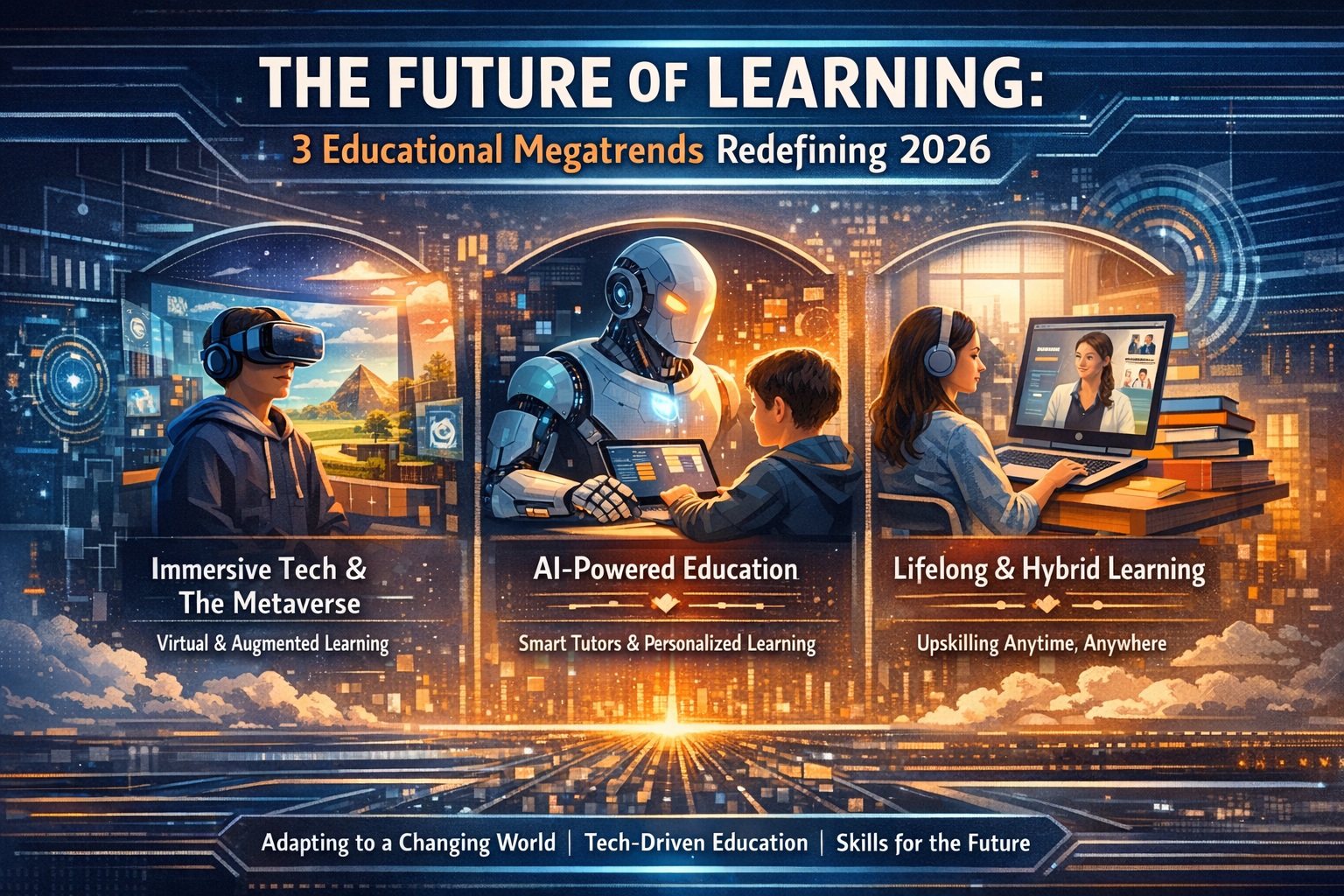
The "Information Age" in education has officially ended. In its place, 2026 has ushered in the "Experience Age." Static PDFs and one-size-fits-all curricula are no longer sufficient for a generation of learners who interact with the world through spatial computing and AI. To stay relevant, educational designers must master three core pillars: Immersive Gamification, Phygital Integration, and Neuro-Inclusive Design.
1. Gamification 2.0: From Points to "Agentic Agency"
In 2026, the trend has moved beyond the "chocolate-covered broccoli" approach of adding badges to boring text. We are now seeing the rise of Agentic AI NPCs and Branching Narrative Mastery.
Beyond the Leaderboard
Traditional gamification often failed because it focused on external rewards (points). Modern materials focus on intrinsic motivation:
- AI-Driven Narrative: Materials now feature AI characters that respond dynamically. A student doesn't just read about history; they negotiate a treaty with an AI-powered diplomat whose reactions change based on the student's logic.
- Procedural Difficulty Adjustment: Using machine learning, the difficulty of educational "quests" scales in real-time, ensuring the learner stays in the "Flow Zone"—the sweet spot between boredom and anxiety.
Key Takeaway: Stop grading the result; start rewarding the process through XP (Experience Points) that emphasize iterative failure and persistence.
2. The Phygital Bridge: Healing the Digital-Physical Divide
After years of "screen fatigue," 2026 marks the return of the physical object—supercharged by the digital layer. This is known as Phygital Learning.
Tactile AR & Smart Manipulatives
Research shows that tactile interaction (using our hands) is essential for memory encoding.
- IoT-Enabled Kits: Imagine a physical chemistry set where the test tubes have embedded sensors. When mixed, a tablet displays a real-time atomic-level simulation of the reaction occurring in the student's hand.
- Spatial Anchors: Modern workbooks now act as "anchors" for Augmented Reality. When scanned, the page doesn't just show a video; it "unfolds" into a 3D workspace where students can dissect a virtual engine or explore a topographic map in their own room.
Why Phygital Wins in SEO and Education
Search intent is shifting toward "hands-on" and "experiential" queries. Materials that bridge this gap are outperforming traditional digital-only assets in both engagement metrics and search visibility.
3. Neuro-Inclusivity: The New "Universal Design" Standard
The most significant shift in 2026 educational material design is the move from accessibility (checking a box) to Neuro-Inclusivity (designing for the brain's natural diversity).
Designing for Cognitive Ease
Neuro-inclusive materials recognize that ADHD, Dyslexia, and Autism are not "limitations" but variations in processing.
- Focus Modes & Sensory Profiles: High-quality digital materials now include a "Sensory Toggle." With one click, a student can switch to a low-distraction interface, high-contrast text, or a "dyslexia-friendly" font like OpenDyslexic.
- Non-Linear Scaffolding: Instead of a rigid Chapter 1 to 10 structure, trendy materials use Knowledge Graphs. Students can choose their path based on their "Executive Functioning" needs that day—tackling big concepts first or starting with small, "micro-atomic" wins.
| Feature | Old Standard (Accessibility) | 2026 Trend (Neuro-Inclusivity) |
| Pacing | Timed tests / deadlines | Mastery-based "Zen" modes |
| Visuals | Static images | Interactive, toggleable sensory layers |
| Navigation | Linear / Menu-based | Knowledge graphs / Adaptive paths |
Conclusion: The "Human-in-the-Loop" Future
As we look toward the end of the decade, the most successful educational materials won't be the ones with the most AI, but the ones that use technology to make the learning experience more human. By combining the thrill of gamification, the reality of phygital tools, and the empathy of neuro-inclusive design, we are finally building a system that fits the learner—not the other way around.
References & Expert Resources
To ensure your curriculum or educational strategy aligns with the latest evidence-based practices, consult these primary sources and industry reports:
On Immersive Gamification & AI Agency
- 2026 EdTech Trend Report: The Rise of Gamified Learning: This comprehensive industry outlook from Instinct Resourcing highlights why gamification is projected to increase eLearning effectiveness by nearly 90% by 2026.
- Beyond Stars and Badges: Emotional Design in 2026: An expert deep dive by Tesseract Learning on how "Agentic AI" and narrative-driven mechanics are replacing traditional points-based systems.
On Neuro-Inclusivity & Universal Design (UDL)
- The Universal Design for Learning (UDL) Guidelines (Version 3.0): The definitive framework by CAST for creating flexible learning environments that accommodate neurodivergent learners through representation and engagement.
- Inclusive Design Strategies for Neurodiverse Environments (2025): A recent peer-reviewed toolkit hosted on ResearchGate that provides practical applications for reducing sensory overload in digital materials.
- UDL in Higher Education: Value for Neurodiverse Learners: A 2025 analysis of how modern UDL principles improve retention and focus for students with ADHD and Dyslexia.
On Phygital Learning & Spatial Computing
- The Phygital School Ecosystem: Bridging the Gap: Insights from Bocconi University on how the integration of physical and digital tools is creating a more resilient and interactive classroom model.
- Active Reading in Phygital Environments: A 2025 Study: This study published in Frontiers in Education explores the cognitive benefits of using physical books paired with augmented reality (AR) companions.
- Phygital Game-Based Learning (PGBL) in Early Education: A research paper from the European Conference on Game-Based Learning documenting the success of multisensory tools in fostering early childhood critical thinking.
