
Last updated on: January 22, 2026
75 Views
Yuvika Rathi
College Student
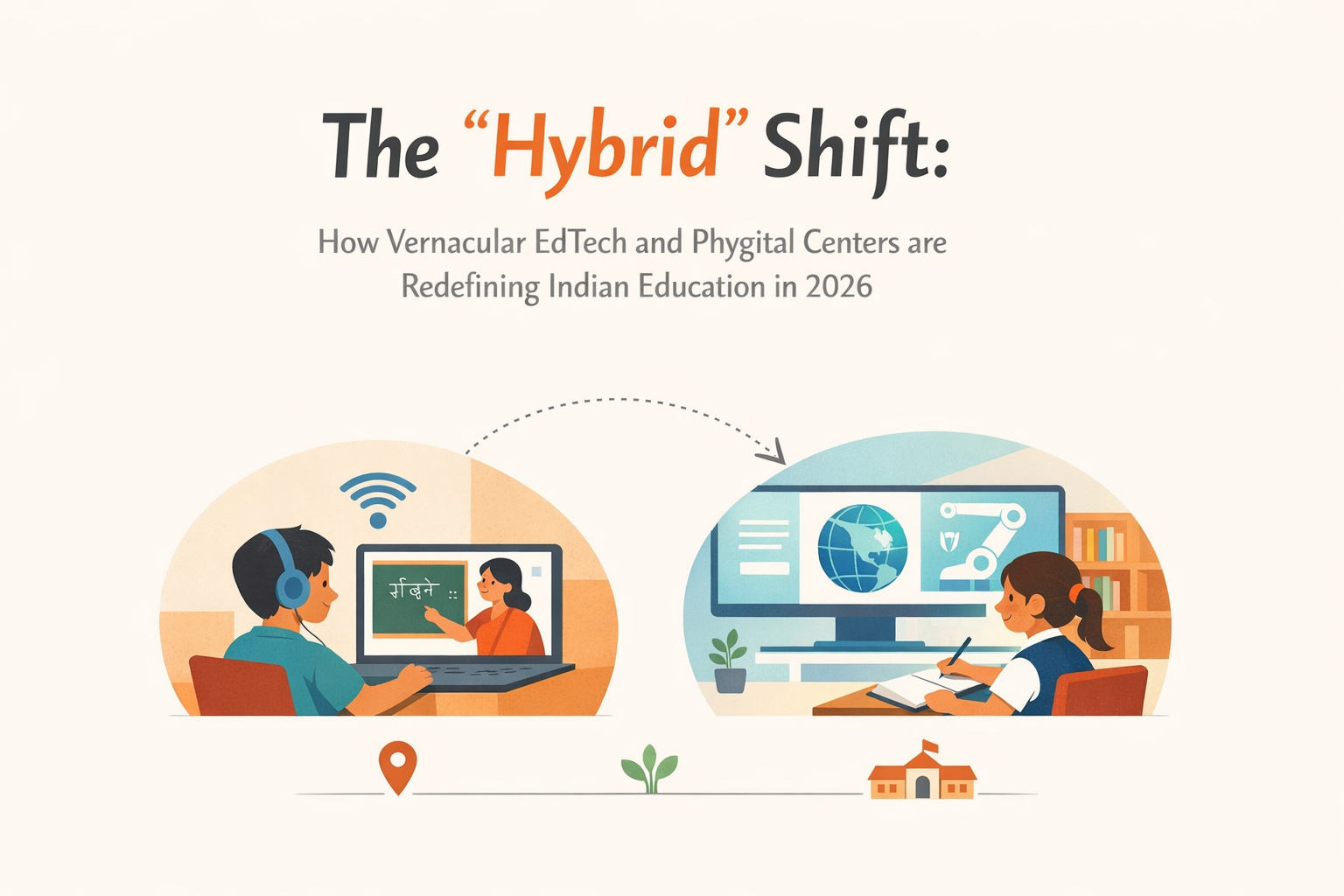
The landscape of Indian education has undergone a tectonic shift. In 2026, the digital divide is no longer just about hardware accessibility; it is about linguistic inclusivity and the fusion of physical and digital environments. As the "Next Half Billion" internet users come online, the demand for vernacular EdTech and "Phygital" (Physical + Digital) learning models has reached an all-time high, fundamentally altering the competitive exam and K-12 sectors in India.
For decades, high-quality educational resources in India were primarily gatekept by the English language. However, following the robust implementation of the National Education Policy (NEP) 2020, there has been a strategic pivot toward mother-tongue instruction.
In 2026, students from Bihar, Tamil Nadu, and Maharashtra are no longer forced to master English before mastering Mathematics or Physics. EdTech platforms have evolved from simple translation to cultural contextualization. Leading platforms now offer comprehensive suites for UPSC, JEE, and NEET entirely in Hindi, Tamil, Telugu, and Marathi, ensuring that cognitive potential is not stifled by linguistic limitations.
While the 2020-2022 era saw a purely digital boom, 2026 is the year of the Hybrid Model. Pure-play online education faced challenges with student discipline and "screen fatigue." To counter this, major Indian EdTech giants have established "Phygital" centers in Tier 2 and Tier 3 cities.
These centers provide:
The 2026 academic year marks a milestone in the integration of the Academic Bank of Credits (ABC) and the vocationalization of education. The focus has moved from rote memorization to competency-based learning. This shift has forced coaching institutes to revamp their SEO and content strategies, moving away from "shortcut tricks" to "conceptual clarity in regional tongues."
The democratization of education through vernacular and hybrid models is leading to a decentralization of the Indian talent pool. With high-quality coaching available in every district of India, the 2026 results for national-level exams are showing a significant increase in toppers from non-metropolitan areas. This trend is not just an educational shift but a socioeconomic one, promising a more equitable distribution of opportunity across the subcontinent.