
Last updated on: February 27, 2026
98 Views
Yuvika Rathi
College Student
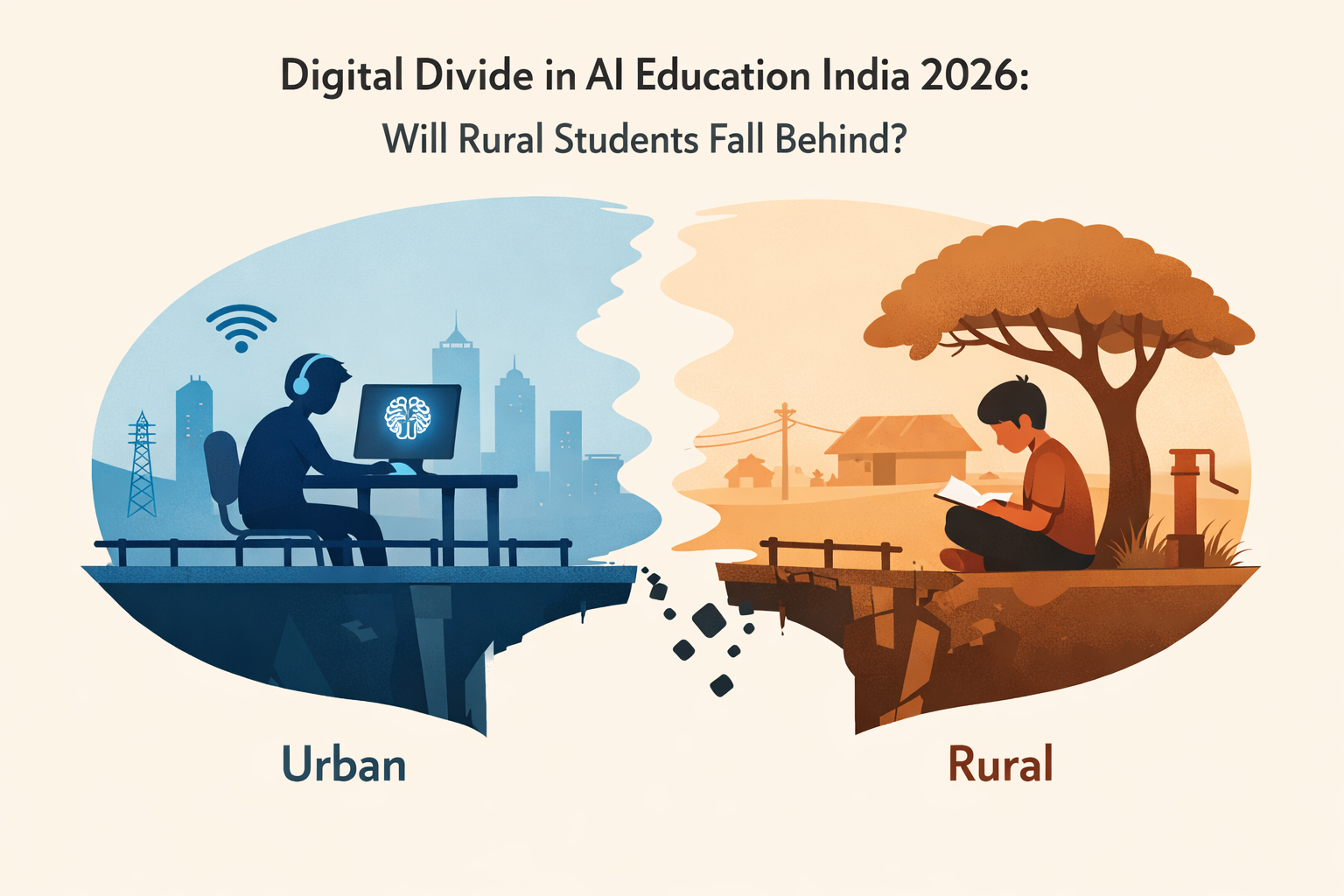
India just made one of the most ambitious educational commitments in its history: starting in the 2026–27 academic year, every student from Class 3 onward will learn Artificial Intelligence and Computational Thinking as part of their core curriculum. It's a declaration that positions India alongside global leaders like Singapore, Finland, and South Korea in preparing students for an AI-driven economy.
But here's the problem nobody wants to say out loud. As of February 2026, only 57.2 percent of schools in India had computers, and 53.9 percent had internet access. In poorer states such as Bihar and West Bengal, those numbers drop below 25 percent Discovery Education. India is about to mandate AI education in classrooms where half the schools don't have reliable electricity.
The government's own data reveals the scale of this mismatch. Only 26.8 percent of Indian youth in the academic age group between 6-14 possess basic internet browsing skills, with Meghalaya and Tripura reporting figures below 10 percent Discovery Education. These are the students who will be asked to understand machine learning, pattern recognition, and algorithmic thinking starting in 2026.
Meanwhile, at the India AI Impact Summit 2026 held just days ago, experts noted that in border schools, basic infrastructure — running water, toilets, and even classrooms with four walls — is often missing QS Quacquarelli Symonds. The conversation isn't about whether these schools can run AI software. It's about whether they have walls.
Private schools in Delhi, Mumbai, and Bengaluru already teach AI as an elective. They have computer labs, trained teachers, partnerships with tech companies, and students who own smartphones. For them, the 2026 mandate is a formalization of what's already happening.
For a government school in rural Madhya Pradesh or Assam, the mandate is a crisis waiting to unfold. Teachers who've never used a computer will be asked to teach computational thinking. Students who've never seen a laptop will be tested on AI concepts. Research indicates that AI's introduction may lead to unfair advantages for some learners due to the languages used by AI, cultural mismatches between AI developers and users, and algorithm bias fundaspring.
Facing these realities, policymakers have proposed "unplugged learning" — teaching AI concepts without digital devices. The government is exploring innovative solutions, such as activities that teach AI concepts without digital devices, making the curriculum accessible even in schools with limited resources OpenAI.
It's a well-intentioned workaround. Students can learn pattern recognition through paper exercises, understand algorithms through board games, and grasp logic through storytelling. But here's the uncomfortable truth: teaching AI without computers is like teaching swimming without water. You can explain the motions, but you're not actually learning the skill.
The winners in this rollout are already clear. Elite private schools, urban Kendriya Vidyalayas, and well-resourced state schools will integrate AI seamlessly. Their students will graduate with genuine AI literacy — the ability to use tools like ChatGPT, code basic algorithms, and understand how machine learning shapes their world.
The students at risk are in the 40-50% of schools without functional computers or internet. They'll receive a watered-down version of the curriculum, taught by undertrained teachers using offline methods, and tested on concepts they've never practically engaged with. Their transcripts will say "AI & Computational Thinking" — but the actual learning gap will be massive.
With over nine million teachers across India, educators form the single largest institutional layer for equitable AI adoption QS Quacquarelli Symonds. Yet the NISHTHA teacher training framework — the government's primary upskilling program — is racing against an impossible timeline. Training materials are due December 2025. Full implementation starts 2026–27. That's six months to prepare 9 million teachers to teach a subject most have never studied themselves.
Educators noted that rural teachers' ground reality differs from what policies outline, with queries such as 'I want to engage my classroom' or 'I want to explain a complex topic in a very simple manner' QS Quacquarelli Symonds — not the advanced AI pedagogical frameworks being drafted in Delhi.
India's AI education mandate is visionary in intent but dangerously unequal in execution. Unless the government invests massively in digital infrastructure, teacher training, and equitable resource distribution over the next year, the 2026 rollout will create a two-tier education system: one where privileged students become AI-literate, and another where disadvantaged students receive certificates without competence. The real test will be not whether India can teach AI, but whether it can teach it justly Discovery Education.