
Last updated on: January 18, 2026
56 Views
Yuvika Rathi
College Student
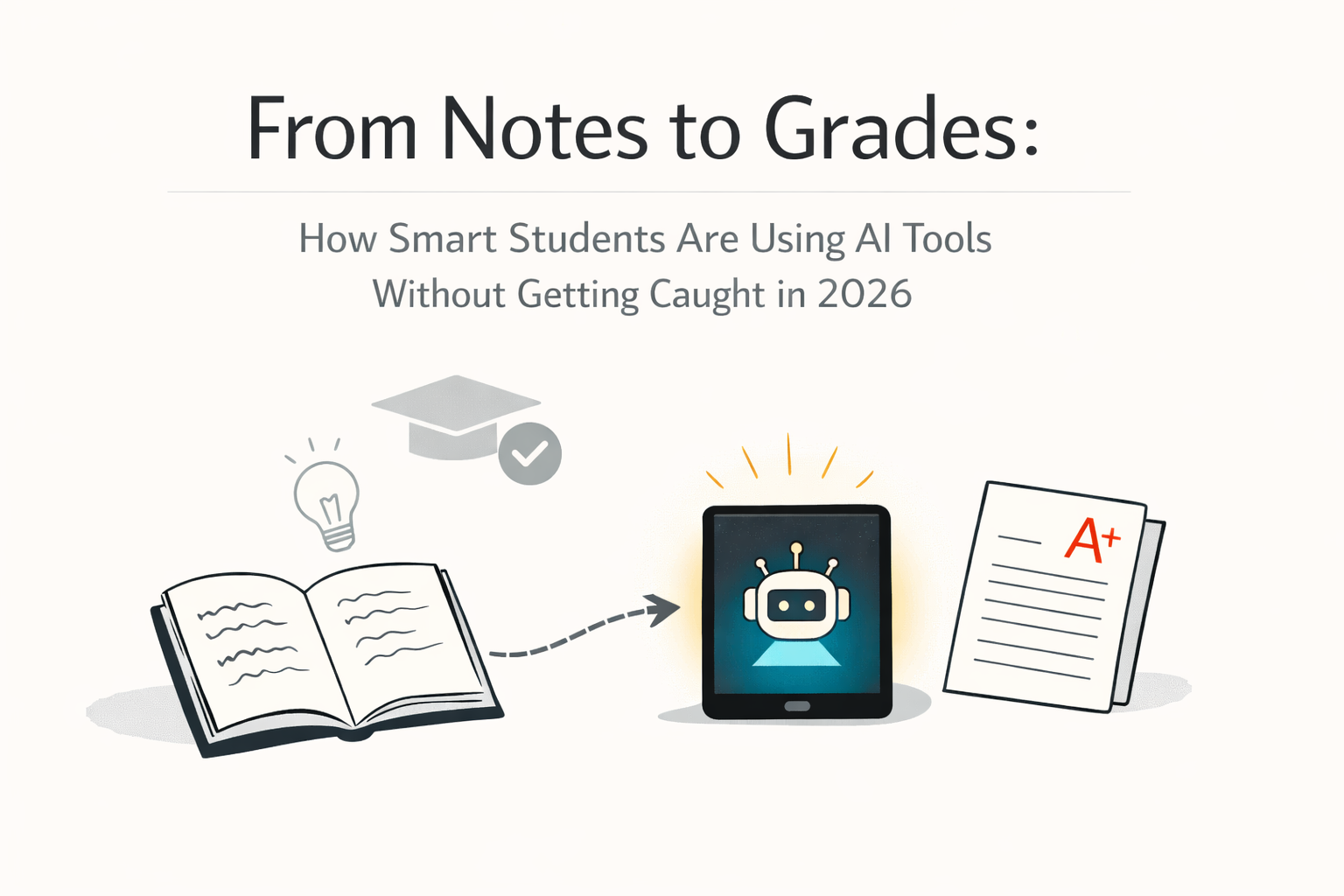
By 2026, AI detection technology has reached a point of near-total precision. Institutional tools can now identify the "fingerprints" of large language models with over 99% accuracy. However, the highest-achieving students are not avoiding AI—they are evolving with it.
The secret to using AI in 2026 isn't about getting the AI to write for you; it's about using it as a Cognitive Architect. Here is how to ethically and effectively integrate AI into your workflow without triggering a single red flag.
The most common mistake students make is asking AI to write a draft. In 2026, detectors look for "burstiness" and "perplexity" patterns unique to AI. To stay safe, you must be the primary author of the prose. Use AI for the Structural Engineering.
Instead of asking for answers, top students use AI to stress-test their knowledge. This is known as the "Socratic Loop."
Smart students use a multi-tool approach to ensure academic integrity. In 2026, the "Hybrid Workflow" is the gold standard:
| Tool Category | Recommended Apps (2026) | Best Use Case |
| Research & Citations | Perplexity AI / ResearchRabbit | Finding real, verifiable academic papers. |
| Note Synthesis | NotebookLM / Notion AI | Connecting dots between your own uploaded lectures. |
| Draft Auditing | Thesify / Grammarly | Improving structure and clarity without changing your voice. |
| Logic Verification | Wolfram Alpha | Checking complex mathematical and scientific reasoning. |
In 2026, many universities have shifted from "Banning AI" to "Regulating AI." A growing trend among top-performing students is the Voluntary AI Disclosure Statement.
Example Disclosure: "Brainstorming and structural outlining assisted by Google Gemini 1.5; all primary research, drafting, and final analysis performed by the author."
By being transparent about your process, you eliminate the suspicion of "getting caught." It shows that you are a technologically literate student who uses modern tools as a professional would.