
Last updated on: November 5, 2025
46 Views
Yuvika Rathi
College Student
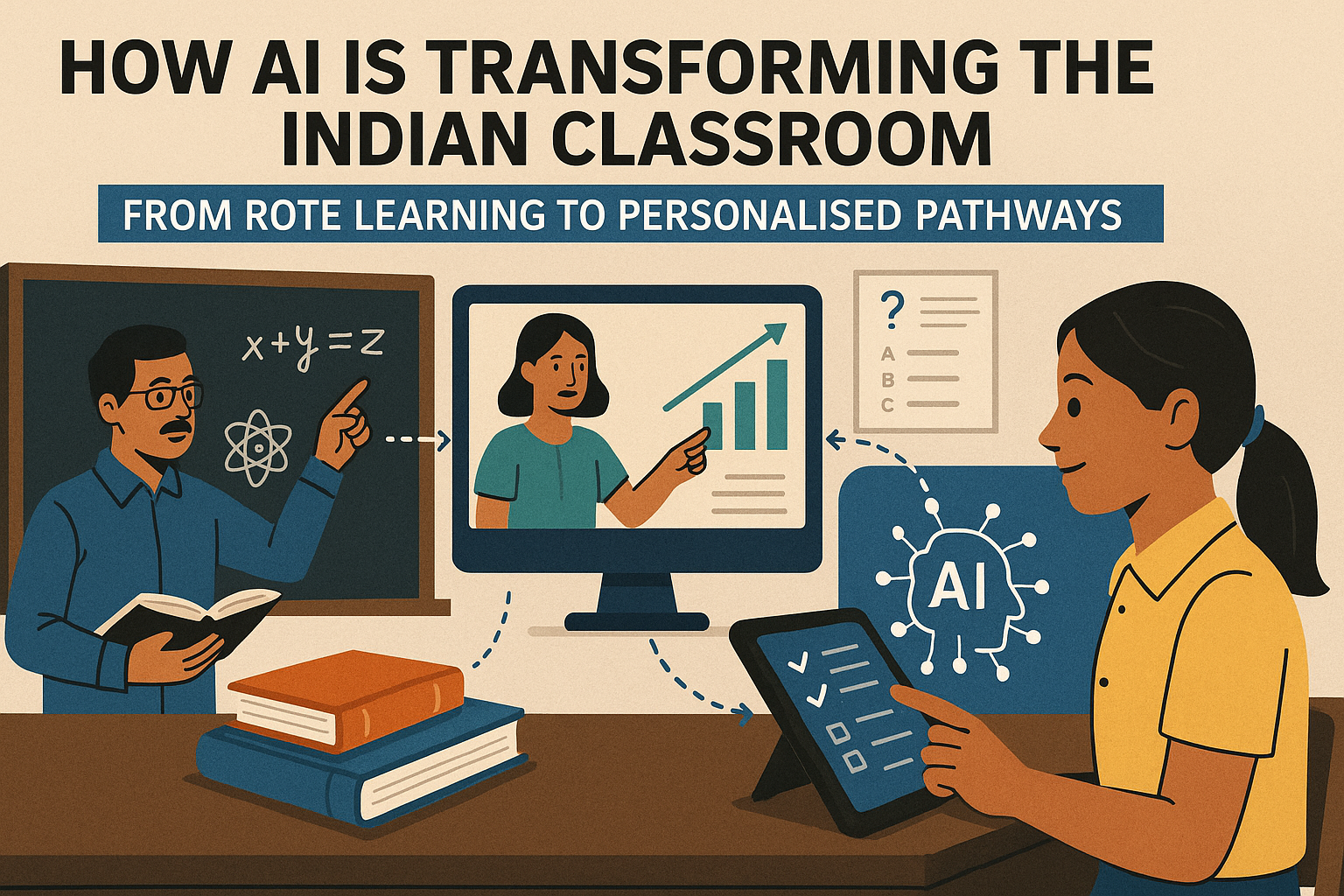
For decades, Indian education has stood on the pillars of discipline, memorisation, and examinations. Students learned to recite before they could reflect. Teachers taught to complete syllabi rather than to spark curiosity. But as Artificial Intelligence (AI) begins to thread its way into classrooms, a quiet revolution is unfolding — one that could finally bridge the gap between learning by heart and learning to think.
The National Education Policy (NEP) 2020 marked a turning point in India’s academic story. It recognised the need for innovation, critical thinking, and flexible learning — three things the AI revolution thrives on.
Today, AI is no longer a futuristic concept discussed in labs; it’s being piloted in CBSE schools, built into EdTech apps, and tested in universities across the country.
With the government’s AI for All initiative and digital expansion across rural regions, the question isn’t whether AI will change Indian education — it’s how deeply it already has.
India’s biggest educational challenge has always been scale. Overcrowded classrooms, uneven teacher-student ratios, and regional disparities have long made personal attention a privilege rather than a norm.
AI offers something radical: personalisation at scale.
Adaptive systems can now analyse how each student learns — where they struggle, what interests them, and how fast they progress. An AI algorithm doesn’t tire, doesn’t forget, and can track patterns no human teacher could monitor for hundreds of students simultaneously.
For a country where nearly 250 million students attend school every day, that kind of intelligence could reshape the learning curve.
Indian EdTech startups have been quick to experiment:
Even government schools in states like Kerala and Maharashtra are testing smart learning platforms that predict learning outcomes and suggest individual improvement paths.
The old Indian classroom worked like a factory — every student learning the same thing, at the same pace, in the same way.
AI disrupts that rhythm.
Now, two students sitting side by side can experience entirely different lessons — one revising a basic concept while the other solves an advanced problem, both guided by data.
Instead of standardising education, AI individualises it.
Learning becomes responsive rather than prescriptive.
Imagine a rural student who once struggled to keep up in a crowded classroom. Through an AI-powered tablet, they receive lessons tailored to their progress and even their local language. For the first time, education bends to fit the learner — not the other way around.
But innovation never comes without questions.
How do we ensure AI doesn’t deepen the digital divide between those with internet access and those without?
How do we protect student data privacy in a system still learning to regulate technology?
And how do we train thousands of teachers — many of whom are only beginning to integrate digital tools — to collaborate effectively with algorithms?
India’s infrastructure gaps remain significant. Rural schools still face power outages, weak connectivity, and lack of devices. Without addressing these, AI could risk becoming another urban advantage rather than a national equaliser.
The biggest misconception about AI in education is that it will replace teachers. It won’t.
If anything, it redefines their purpose.
Teachers become interpreters of data, mentors of emotion, and designers of learning experiences that machines cannot replicate.
AI can analyse a student’s weakness — but only a teacher can encourage them through it.
AI can suggest a topic — but only a teacher can make it matter.
For this transformation to succeed, teacher training must evolve too. Institutions need to prepare educators not to fear AI but to use it as a co-teacher.
The government’s Digital India and AI for All programs, combined with NEP 2020, set a clear path toward an intelligent education ecosystem.
Startups, universities, and tech giants like Microsoft, Google, and Intel are partnering to bring machine learning, coding, and ethical AI training to students as young as class six.
By 2030, India could be home to one of the world’s largest AI-literate generations — a workforce that understands not only how to use technology but how to question it.
AI can personalise learning. It can teach faster, test smarter, and predict better.
But it cannot dream, inspire, or empathise — at least not yet.
The future of Indian education lies in this balance: where algorithms shape the system, but humans shape the soul.
Because no matter how intelligent a classroom becomes, the true revolution will always begin in the curiosity of a student and the compassion of a teacher.
References & Useful Sources