
Last updated on: February 27, 2026
143 Views
Yuvika Rathi
College Student
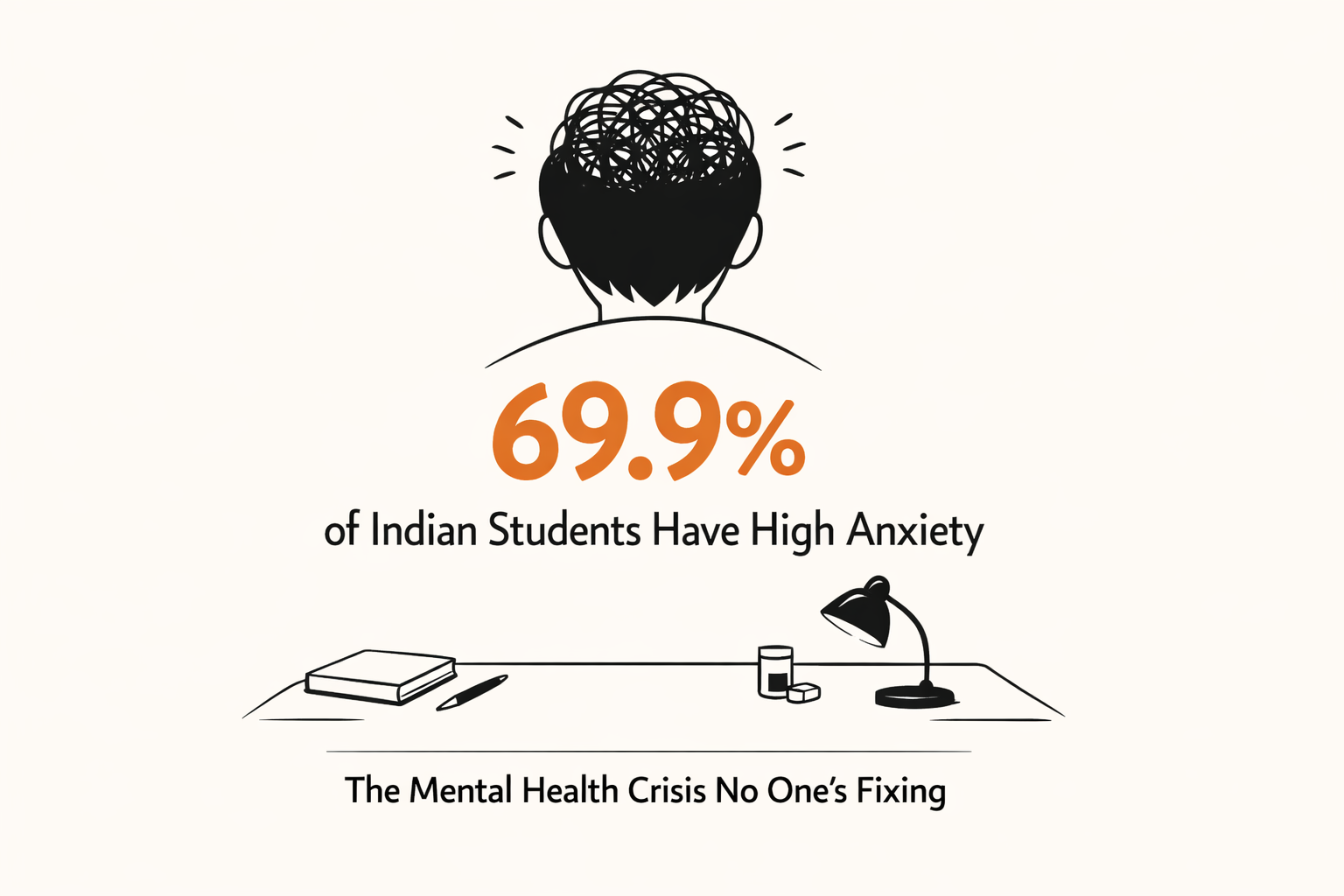
The majority exhibited moderate to high levels of anxiety (69.9%), depression (59.9%), loss of behavioral/emotional control (65.1%), and distress (70.3%). This isn't speculation. It's data from a landmark 2025 study surveying 1,628 students aged 18–29 across eight major Indian cities. Nearly 7 out of every 10 college students in India are living with clinically significant anxiety.
Despite this high prevalence, UNICEF 2021 data shows that less than 10% of youth access mental health services. The gap between need and access isn't closing. It's widening.
In July 2025, the Supreme Court of India issued 15 binding mental health guidelines for all educational institutions in the country. In 2022, India recorded over 13,000 student suicides (7.6% of all suicides), with more than 2,200 directly linked to exam failures. That's 35 students dying every single day — many in coaching hubs like Kota, where academic pressure has become lethal.
The Supreme Court observed that all educational institutions with 100 or more enrolled students shall appoint at least one qualified counsellor, and all staff must undergo biannual mental health training on crisis response and identification of warning signs OpenAIEducation for All in India. But here's the problem: most colleges don't have even one counselor. And the ones that do often have waiting lists stretching weeks.
The National Mental Health Survey 2015-16 estimates India's treatment gap for mental health illnesses at an alarming 70-92 percent, with poor awareness, limited number of specialists, and resource constraints as the primary causes. India has only 0.75 psychiatrists per lakh population, far below the WHO-recommended norm of 3 per lakh.
Translation: even if students want help, the system can't deliver it. A student at a tier-2 city college experiencing suicidal ideation often has zero access to on-campus mental health professionals. Despite the prevalence, a minimal number of young adults accessed mental health services, often due to stigma and cultural biases.
Student-reported drivers of the student mental-health crisis list increased academic stress (37%), prevalence of social media (33%), and rising loneliness (29%) as leading contributors. But these aren't independent variables. They're compounding.
A student preparing for NEET or JEE spends 12–14 hours daily in coaching classes, isolated from family, living in hostel conditions with minimal supervision, scrolling through Instagram reels showing peers "making it" while they spiral into self-doubt. 37.2% of medical students report suicidal ideation. That's not stress. That's systemic failure.
The Supreme Court's July 2025 guidelines are comprehensive. They mandate counselors, ban performance-based student segregation, require helpline number displays, and demand annual mental health reports from every institution. All states and union territories have two months to notify rules, district-level monitoring committees are to oversee compliance, and the Union government has to file a progress report by 27 October 2025.
But as of February 2026, compliance remains patchy. Private universities in metros are moving faster. State-affiliated colleges in smaller cities are lagging. Students are left waiting for infrastructure that was supposed to arrive six months ago.
Students aren't waiting for institutions to catch up. They're turning to peer support networks, anonymous online forums, and Tele-MANAS — the government's 24/7 mental health helpline. More than 23 lakh calls have been handled on the helpline number . But phone counseling is triage, not treatment. It keeps people alive. It doesn't fix the underlying crisis.
With studies showing 69.9% of students experiencing moderate to high anxiety and 59.9% experiencing depression, campuses cannot treat mental health as separate from academic success — it must be woven into institutional policy. The Supreme Court has given the framework. The data has shown the scale. What's missing is execution. Until every college with 100+ students has a qualified counselor on payroll, India's mental health crisis will remain a policy document — not a solution.

Sep 28, 2025
Feb 27, 2026

Jan 27, 2026
May 21, 2025

Feb 27, 2026

Sep 10, 2025

May 2, 2026

Jan 22, 2026

Sep 9, 2025

Sep 17, 2025

Sep 20, 2025
Feb 16, 2026

Sep 9, 2025

May 21, 2025

May 3, 2025