
Last updated on: January 28, 2026
26 Views
Yuvika Rathi
College Student
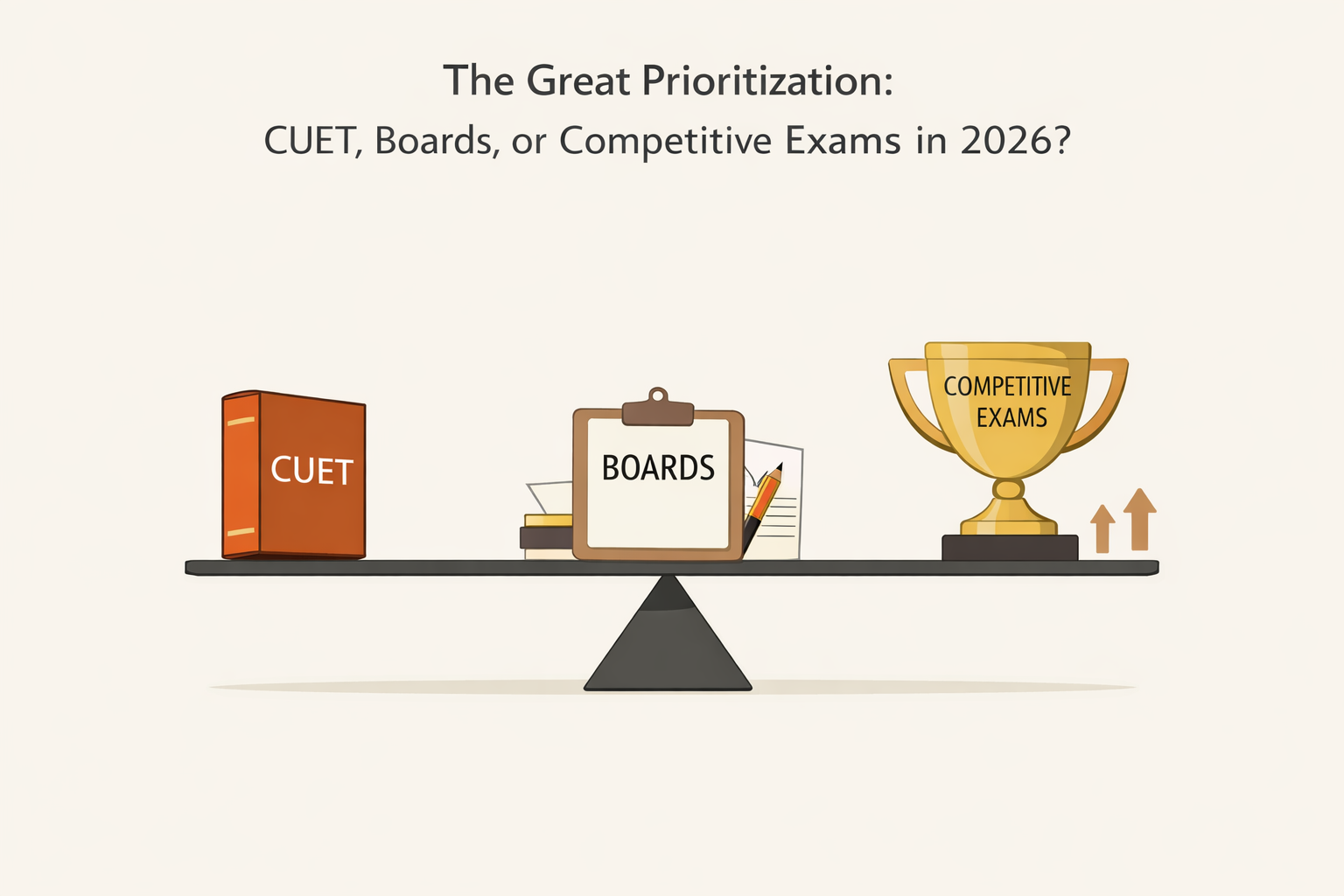
For the Indian student cohort of 2026, the academic calendar is no longer a linear path; it is a high-stakes strategic battlefield. With the Common University Entrance Test (CUET) now fully matured, the traditional "Boards-first" mentality has collided with the "Entrance-only" focus of JEE and NEET.
The result? A generation of students forced to act like portfolio managers, allocating their limited time across three distinct evaluation systems.
In 2026, the "Priority Matrix" is determined by a student’s ultimate exit point. However, a significant shift has occurred: The Board Exam is no longer the destination; it is the "Safety Net."
For those eyeing Delhi University (DU), BHU, or JNU, CUET is the undisputed king.
For engineering and medical hopefuls, 2026 has brought "Exam Fatigue."
A new breed of student has emerged in 2026: the one who takes both JEE/NEET and CUET as a backup for B.Sc. or Economics hons. This group faces the highest risk of burnout.
To understand where to put your energy, you must understand the "DNA" of each exam.
| Feature | Board Exams (2026) | CUET (UG) 2026 | JEE / NEET 2026 |
| Primary Goal | Certification & Eligibility | University Placement | Professional Stream Entry |
| Question Type | Subjective & Descriptive | Objective (MCQ) | Complex Objective / Multi-select |
| Syllabus Focus | Class 12 (Comprehensive) | Class 12 (NCERT-centric) | Class 11 & 12 (Deep Application) |
| Success Metric | Percentage (%) | Percentile | All India Rank (AIR) |
Toppers are navigating 2026 by shifting their "Primary Focus" based on the calendar.
In 2026, "diversification" is the only hedge against a bad exam day. The smartest students are those who maintain a 75% Board baseline while specializing in the specific "testing logic" of their chosen entrance exam.