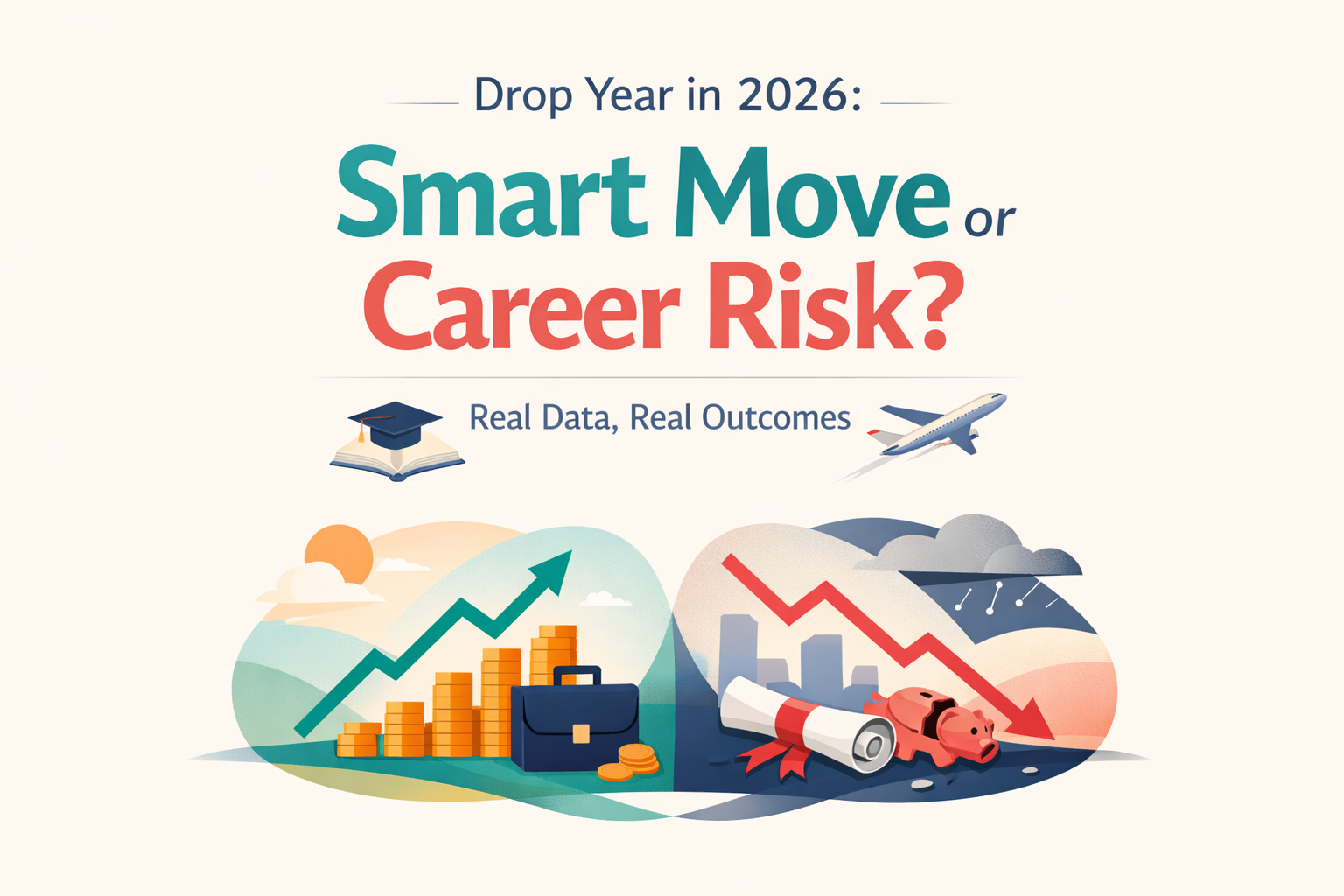
The "Drop Year" remains one of the most polarizing decisions in the Indian education system. As we enter 2026, the stakes have shifted. With JEE Main mandatory patterns changing, NEET competition hitting record highs, and CUET becoming the primary gateway for central universities, the traditional "gap year" is no longer just about studying harder—it is about weighing a calculated risk against evolving market realities.
1. The Success Statistics: Droppers vs. Freshers
Real-time data from the 2024–2025 cycle reveals a surprising trend in high-stakes exams. While freshers often have the advantage of "academic momentum," droppers currently hold a significant share of the top ranks in technical streams.
- JEE Advanced Success Rate: Data suggests that approximately 40–45% of students who secure seats in the IITs are droppers. The "repeater advantage" comes from having already cleared the board exam hurdle, leaving 100% of the daily schedule for competitive problem-solving.
- NEET UG Persistence: In the medical stream, the "drop culture" is even more pronounced. Nearly 60% of students in government medical colleges (MBBS) have taken at least one drop year.
- The CUET Risk Factor: Unlike JEE/NEET, a drop for CUET is considered riskier. Since CUET is largely NCERT-based, the "knowledge gap" between a fresher and a dropper is narrow. Statistics show that the success rate improvement for CUET droppers is only 12–15%, compared to the 30%+ jump seen in JEE aspirants.
| Exam | % of Droppers in Top 50,000 | Avg. Score Improvement | Risk Level |
| JEE Main | 35% | 25–40 Percentile jump | Moderate |
| NEET UG | 58% | 100–150 Marks jump | High |
| CUET UG | 18% | 5–10% Score jump | Very High |
2. The Placement Myth: Does a Gap Year Hurt Your Job?
A major "bluff" often used to discourage droppers is that top companies won't hire you. In 2026, this is largely false, with some specific caveats.
- IT & Product Giants: Companies like Google, Amazon, and even Indian giants like TCS and Infosys have moved to a "Skills-First" model. A one-year gap between Class 12 and College is almost never a filter. They care about your CGPA inside college and your technical portfolio.
- The "Double Drop" Warning: Taking two years off (Double Drop) can raise red flags for Tier-1 management consultancies or high-finance roles (e.g., Goldman Sachs, BCG). They value "consistency of progression." If you take two years off, you must have a "skill-based" justification (e.g., a certification or a project) to show you weren't just idle.
- Core Engineering: For PSU (Public Sector Undertaking) jobs via GATE, a gap year has zero impact. They strictly follow merit and age-limit criteria.
3. The 2026 Mental Health "Burnout" Data
The hidden cost of a drop year in 2026 is psychological. Recent surveys of "repeaters" indicate that the "Fatigue Factor" hits its peak in November–December.
- The Illusion of Competence: Droppers often feel they "know" a topic because they've seen it before, leading to a lack of depth in practice.
- Social Isolation: In 2026, with peers posting "College Life" updates on social media, droppers face a 40% higher risk of anxiety-driven performance dips compared to freshers.
- Outcome: Students who joined a Hybrid/Offline test series had a 22% higher success rate than those who did purely isolated self-study, due to the "competitive environment" factor.
Is it a "Smart Move" for You?
Take the Drop ONLY if:
- Your 2025 score was within 15–20% of the target cutoff.
- You have identified specific "silly mistakes" or "time management" issues rather than a total lack of interest in the subjects.
- You have a support system that understands a drop year is a marathon, not a sprint.
AVOID the Drop if:
- You are dropping only due to parental pressure.
- Your score was significantly below the 50th percentile (the "Foundation Gap" may be too wide for one year).
- You are eligible for a good Tier-2 college and can focus on "Up-skilling"
Reference Links & Direct Data Sources
- NTA Success Statistics (Year-wise): nta.ac.in/Downloads
- IIT Bombay Placement Cell (FAQ on Gap Years): placement.iitb.ac.in
- Vedantu Analysis: Droppers vs. Regulars: vedantu.com/blog/jee-dropper-statistics
- Careers360 Gap Year Impact Analysis: engineering.careers360.com
- NEET Dropper Success Trends (Physics Wallah Data): pw.live/neet-dropper-strategy
