
Last updated on: March 9, 2026
200 Views
Yuvika Rathi
College Student
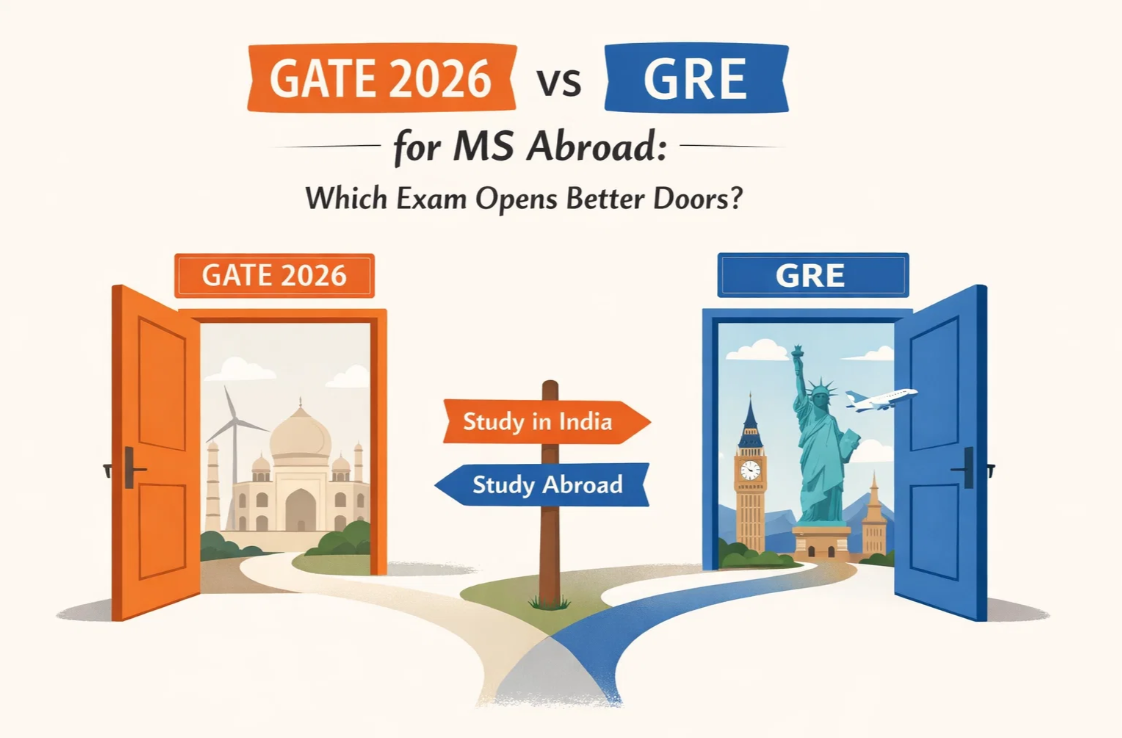
Every GATE coaching center in India runs the same pitch: "Score 90+ percentile in GATE and study at TU Munich for free! Skip the expensive GRE!" It sounds perfect — one Indian exam, zero tuition in Germany, world-class education. Lakhs of engineering graduates buy into this narrative annually.
Here's what they don't tell you until after you've paid for the course: GATE acceptance abroad is geographically microscopic. The USA doesn't accept GATE. Canada doesn't accept GATE. The UK doesn't accept GATE. Australia barely accepts GATE. Your 95 percentile GATE score — which could get you into IIT Bombay — is worthless at Stanford, MIT, Toronto, Oxford, or Melbourne.
GATE opens exactly two countries for MS: Germany and Singapore. That's it. If your dream school is anywhere else on the planet, you're taking the GRE whether you like it or not.
Germany: Technical University of Munich, RWTH Aachen University, and select TU9 institutions accept GATE scores for specific English-taught Master's programs. Minimum requirement: 90th percentile. Programs accepting GATE include Applied Geophysics, Automotive Engineering, Media Informatics, and Software Systems Engineering. Important caveat: IIT graduates are often exempt from GATE requirements entirely at German universities — their transcripts alone suffice.
Singapore: National University of Singapore and Nanyang Technological University accept GATE for postgraduate engineering and research programs. Minimum requirement: 90th percentile highly competitive. NUS accepts GATE for select Master's programs under the Faculty of Engineering. NTU uses GATE as a GRE substitute for engineering streams.
That's the complete list. No other country has systematic GATE acceptance at scale.
United States: 134 ranked universities accept GRE. Every major MS program in Computer Science, Electrical Engineering, Mechanical Engineering, Data Science, and STEM fields requires GRE. No exceptions. No substitutes. Stanford, MIT, Carnegie Mellon, Berkeley, Georgia Tech — all mandatory GRE.
Canada: Universities like University of Toronto, University of British Columbia, McGill University, and University of Waterloo require GRE for competitive MS programs. The three-year Post-Graduation Work Permit pathway to Canadian PR requires a Canadian Master's degree — which requires GRE.
United Kingdom: While many UK universities don't strictly require GRE, top programs at Imperial College London, University of Cambridge, and University of Oxford increasingly prefer or require GRE for competitive applicants. London School of Economics explicitly lists GRE or GMAT requirements on select program pages.
Australia: University of Melbourne, Australian National University, and other Group of Eight universities accept GRE for research-based MS and PhD programs. GATE acceptance is minimal and program-specific.
The pattern is clear: GRE opens 1300+ universities across six continents. GATE opens approximately 10-15 universities in two countries.
GATE examines engineering depth. Computer Science GATE covers algorithms, data structures, operating systems, computer networks, databases, compiler design, digital logic, and theory of computation — essentially your entire BTech curriculum compressed into one three-hour exam. Negative marking applies: minus one-third mark for one-mark MCQs, minus two-thirds for two-mark MCQs.
The exam tests whether you genuinely understand the engineering fundamentals you supposedly learned over four years. For students who studied diligently during undergrad, GATE preparation is revision. For students who coasted through BTech, GATE is brutal relearning from scratch.
Preparation timeline: six to eight months of serious commitment. This isn't weekend studying. It's dedicated, structured, full-coverage preparation across every subject in your branch's GATE syllabus.
GRE examines aptitude, not technical knowledge. Verbal Reasoning tests vocabulary, reading comprehension, and critical reasoning — skills unrelated to engineering. Quantitative Reasoning tests high school-level math: algebra, geometry, data analysis. No calculus. No differential equations. No circuit analysis.
For Indian engineering students, GRE Quant is laughably easy. A student who scored 70 percent in Class 10 CBSE Math can score 165+ in GRE Quant with two months of practice. The challenge is Verbal Reasoning, which requires vocabulary building and reading comprehension skills most Indian engineers haven't developed since Class 12 English.
No negative marking in GRE. You can guess freely. Adaptive testing means the exam adjusts difficulty based on your performance — perform well in the first section, face harder questions in the second section worth more points.
Preparation timeline: three to four months with flexible test dates. GRE can be scheduled at your convenience. GATE happens once annually in February — miss it, wait a full year.
Germany's public universities charge zero tuition. Semester contribution is approximately 250-350 euros twice annually. Total two-year MS cost at TU Munich: 620 euros in university fees. That's approximately 56,000 rupees for a degree from a QS-ranked Top 30 university.
But here's the fine print nobody emphasizes:
Living costs in Munich: 1112 euros monthly minimum wage if working 20 hours weekly. Without part-time work, you need 11,904 euros annually in a blocked account for visa approval — approximately 10.7 lakh rupees deposited upfront per year.
IELTS/TOEFL requirement: Most English-taught programs require minimum IELTS 6.5 or TOEFL 90. Cost: 16,250 rupees for IELTS, 16,900 rupees for TOEFL.
APS Certificate requirement: Mandatory for Indian students applying to German universities. This credential verification process costs approximately 18,000 rupees and takes 2-4 months.
Language reality: While programs are English-taught, daily life in Germany requires basic German. Most students spend 6-12 months learning German A1-A2 level before departure. Language course costs: 20,000-40,000 rupees.
Total upfront cost for two-year MS in Germany with GATE: approximately 25-30 lakh rupees including blocked account, living expenses, language training, and credential verification. Not free. Just structured differently.
GRE exam fee: 23,452 rupees official price (21,299 rupees with discount platforms like EduVouchers). Universities in USA, Canada, UK charge tuition ranging from 30,000 USD to 60,000 USD for MS programs.
Total two-year MS cost in USA: 70-90 lakh rupees including tuition, living expenses, health insurance. Canada: 50-70 lakh rupees. UK: 40-60 lakh rupees.
But here's what changes the ROI calculation:
Post-graduation salaries: Average starting salary for MS graduates in USA: 40,000-55,000 euros annually. In Germany: 40,000-45,000 euros annually for similar engineering roles.
Work permit duration: USA OPT allows one year work authorization, extended to three years for STEM fields. Canada PGWP allows three years work authorization with direct PR pathway. Germany allows 18-month job-seeker visa post-graduation with EU Blue Card pathway to PR.
Loan repayment timelines: An MS graduate in USA earning 90,000 USD annually can repay a 70 lakh rupee education loan in 3-4 years. An MS graduate in Germany earning 45,000 euros annually takes similar time despite lower debt because salaries are also lower and taxes are higher.
Technical University of Munich ranks QS 28 globally. RWTH Aachen ranks QS 105. National University of Singapore ranks QS 8. Nanyang Technological University ranks QS 26. These are legitimately elite institutions. A degree from TU Munich or NUS carries significant global weight.
But here's the reality: you're competing for approximately 50-100 GATE-accepting seats per program across these universities. NUS and NTU combined accept roughly 300-400 Indian students annually across all GATE-eligible programs. TU Munich and RWTH Aachen accept even fewer.
The competition is murderous. A 90th percentile GATE score gets you eligibility, not admission. You're competing against IIT graduates with 90+ percentile, 8.5+ CGPA, strong research publications, and stellar recommendations. The acceptance rate for Indian applicants to TU Munich's Computer Science programs using GATE is estimated below 10 percent.
GRE opens Stanford (QS 3), MIT (QS 1), Carnegie Mellon (QS 52), Georgia Tech (QS 97), University of Toronto (QS 21), ETH Zurich (QS 7), and 1300+ other institutions globally.
The strategic advantage: diversification. A student with 320 GRE (160V + 160Q) and 3.5 GPA can apply to 10-15 universities spanning USA, Canada, UK, and Europe. Some will reject. Some will admit. Some will offer funding. This portfolio approach drastically increases admission probability.
A student with 95 percentile GATE can apply to exactly four universities: TU Munich, RWTH Aachen, NUS, NTU. If all four reject — which happens frequently — you've wasted a full year. GATE happens once annually. Rejection means waiting until next February, reappearing, and reapplying.
MS graduates from TU Munich or NUS enter European or Singaporean job markets. Starting salaries: 40,000-50,000 euros in Germany, 65,000-75,000 SGD in Singapore. Both markets offer strong work-life balance, social benefits, and clear pathways to permanent residency.
The trade-off: salary growth plateaus faster. A software engineer in Germany reaches 70,000-80,000 euros after 5-7 years and stays there unless moving into senior management. European compensation structures are compressed compared to American or Asian tech hubs.
Singapore offers higher ceilings — senior engineers at tech firms can reach 150,000-200,000 SGD — but competition is fierce and long-term immigration remains challenging for non-Singaporeans.
MS graduates from American universities enter the most lucrative job market globally for tech professionals. Starting salaries for software engineers: 90,000-120,000 USD at standard companies, 150,000-200,000 USD at FAANG or top startups. After 5 years, senior engineers reach 200,000-300,000 USD total compensation.
Canadian salaries are lower but still strong: 70,000-90,000 CAD starting, climbing to 120,000-150,000 CAD for senior roles. The advantage: Canada's Express Entry PR pathway treats Canadian Master's degrees favorably, and three-year PGWP allows extended work experience accumulation.
UK salaries are moderate: 35,000-45,000 GBP starting for engineers, climbing to 60,000-80,000 GBP for senior roles. The two-year Graduate Route visa provides work authorization, but long-term immigration remains complex.
You're determined to study specifically in Germany or Singapore regardless of other options. Your family budget cannot accommodate 50+ lakh rupees for MS abroad. You scored 95+ percentile in GATE with strong undergrad GPA from a reputable Indian engineering college. You're applying to research-focused programs where GATE-accepting faculty explicitly recruit Indian students. You're comfortable with the 18-month European job market timeline for securing permanent roles post-graduation.
You want maximum university options across USA, Canada, UK, Australia, and Europe. You're targeting top-20 global universities like Stanford, MIT, or Carnegie Mellon. You need the flexibility to apply to 10-15 universities and compare admits before deciding. Your career goal is high-growth tech sectors where American or Canadian experience provides maximum leverage. You want post-graduation work authorization exceeding 18 months (USA OPT three years for STEM, Canada PGWP three years).
Take both exams if timeline permits. GATE happens in February. GRE can be scheduled anytime. Scoring 90+ percentile in GATE plus 320+ in GRE maximizes optionality. Apply to TU Munich and NUS with GATE. Apply to Stanford and Toronto with GRE. Choose based on admits received, not hypothetical preferences.
This strategy costs an additional 23,000 rupees (GRE fee) but eliminates the risk of GATE rejection leaving you with zero admit options.
GATE versus GRE isn't about which exam is "better." It's about geographic constraints and career outcomes.
GATE works if you've decided Germany or Singapore are your only acceptable destinations and you're prepared for brutally competitive admissions at approximately 10-15 universities total. It's cost-effective, high-quality education with strong European career pathways.
GRE works if you want maximum flexibility, global university access, higher salary ceilings in American markets, and portfolio admissions strategy spreading risk across 10-15 applications.
The students who regret their choice are those who took GATE because coaching centers promised "free education" without understanding that GATE limits them to two countries with 10 percent acceptance rates at top programs. By the time they realize this — after GATE rejection letters arrive in April — application deadlines for GRE-accepting universities have passed.
The students who win are those who made the geographic decision first, then chose the exam that unlocks their target geography. If you know you want to work in Silicon Valley, don't take GATE. If you know you want to settle in Munich long-term, don't waste money on GRE. And if you're genuinely uncertain? Take both. Maximize your doors. Decide when you have multiple admits in hand.
The exam doesn't determine your future. Your geographic preferences and career goals do. The exam just determines which doors you're allowed to knock on.