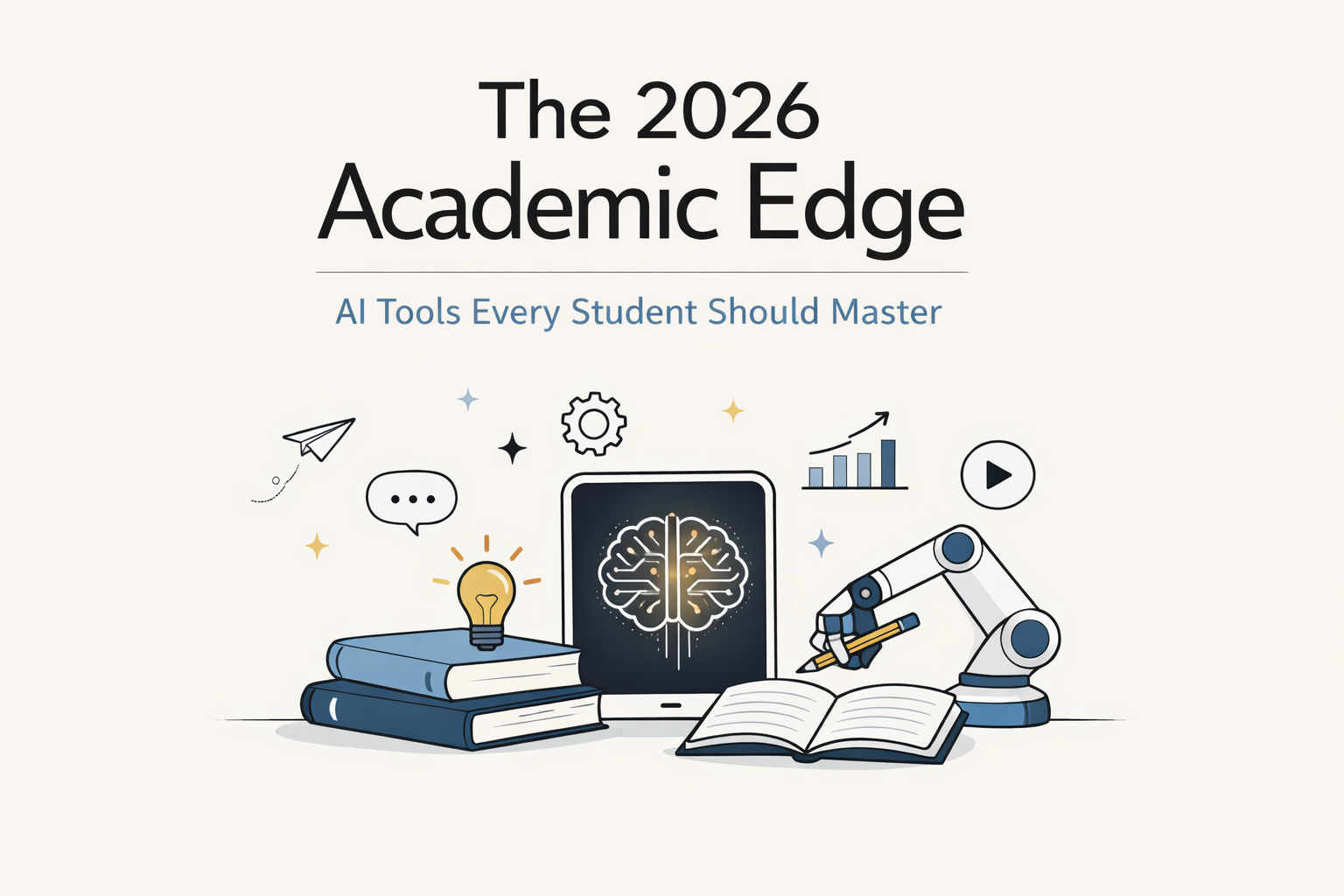
The educational landscape of 2026 is no longer defined by who spends the most hours in the library, but by who best leverages the "Silicon Tutor." As AI models have evolved from simple chatbots into sophisticated research agents, students are utilizing a specialized stack of tools to automate the mundane and amplify the intellectual.
For the modern student, the goal is "Augmented Intelligence"—using AI to synthesize information faster while maintaining the critical thinking that earns top marks. Here is the definitive list of AI tools for study, notes, and assignments in 2026.
1. The Research Powerhouses: Beyond Google Scholar
In 2026, the primary challenge isn't finding information; it's verifying it. These tools prioritize source-grounded data over generative "hallucinations."
- Perplexity AI: Functioning as a conversational search engine, Perplexity provides direct answers to complex queries with real-time citations. It is the gold standard for starting an assignment without falling into the "wiki-hole."
- Consensus: A dedicated search engine that uses AI to extract findings directly from peer-reviewed scientific research. If you ask, "Does caffeine improve long-term memory?", Consensus will provide a "Consensus Meter" based on thousands of actual papers.
- Elicit: Designed for literature reviews, Elicit automates the process of finding relevant papers, summarizing key takeaways, and extracting data into structured tables.
2. The Smart Note-Takers: From Lecture to Library
Static notebooks are obsolete. The 2026 student uses AI that "listens" and "organizes" dynamically.
- Google NotebookLM: This is the breakout tool of the year. You can upload your class PDFs, textbooks, and lecture transcripts into a "notebook," and the AI becomes an expert on only that material. It can generate study guides, FAQs, and even "deep dive" audio summaries of your specific curriculum.
- Otter.ai: Essential for live lectures. Otter doesn't just transcribe; it uses AI-powered summarization to highlight key action items and concepts in real-time, allowing students to focus on the professor rather than their keyboard.
- Notion AI: For those who want an "All-in-One" workspace. Notion’s integrated AI can summarize your messy notes, translate them into 20+ languages, and even draft a project plan based on a syllabus you’ve just pasted.
3. Writing & Assignment Architects
Writing in 2026 is about clarity, tone, and integrity.
- Grammarly (2026 Edition): Far beyond a spellchecker, Grammarly now acts as a strategic writing partner. It can suggest structural changes, detect "AI-tone" to help you maintain your unique voice, and even estimate how a professor might grade your essay based on a provided rubric.
- QuillBot: While often used for paraphrasing, its 2026 "Co-Writer" feature helps students overcome writer's block by suggesting the next logical sentence or helping to transition between complex paragraphs.
- WolframAlpha: Still the undisputed king for STEM students. It doesn't just give answers to calculus or physics problems; it provides step-by-step computational intelligence, helping students understand the logic behind the solution.
Strategic Comparison: The Student’s AI Stack
| Category | Primary Tool | Key 2026 Feature | Use Case |
| Research | Perplexity AI | Real-time Citable Search | Essay bibliographies |
| Synthesis | NotebookLM | Grounded AI Tutoring | Pre-exam revision |
| Writing | Grammarly | Rubric-based Feedback | Finalizing assignments |
| STEM | WolframAlpha | Step-by-Step Logic | Math & Physics HW |
The Ethics of 2026: A Wall Street Journal Perspective
As AI becomes ubiquitous, the "Wall Street" of academia—top-tier universities—has pivoted. They no longer ban AI; they grade based on AI-Intervention. Students are expected to disclose their AI "co-pilots." Using AI to generate your essay is plagiarism; using it to critique your logic and source your data is the new standard of professional excellence.
Pro-Tip: Always cross-reference AI-generated citations. Even the best 2026 models can occasionally misattribute a quote or a study.
Reference Links for Further Research:
- Perplexity AI - The Future of Search
- Google NotebookLM - Grounded Research Tool
- Consensus - AI Search Engine for Research
- Otter.ai - Voice Meeting & Lecture Notes
- WolframAlpha - Computational Intelligence
- UNESCO: Guidance for Generative AI in Education and Research