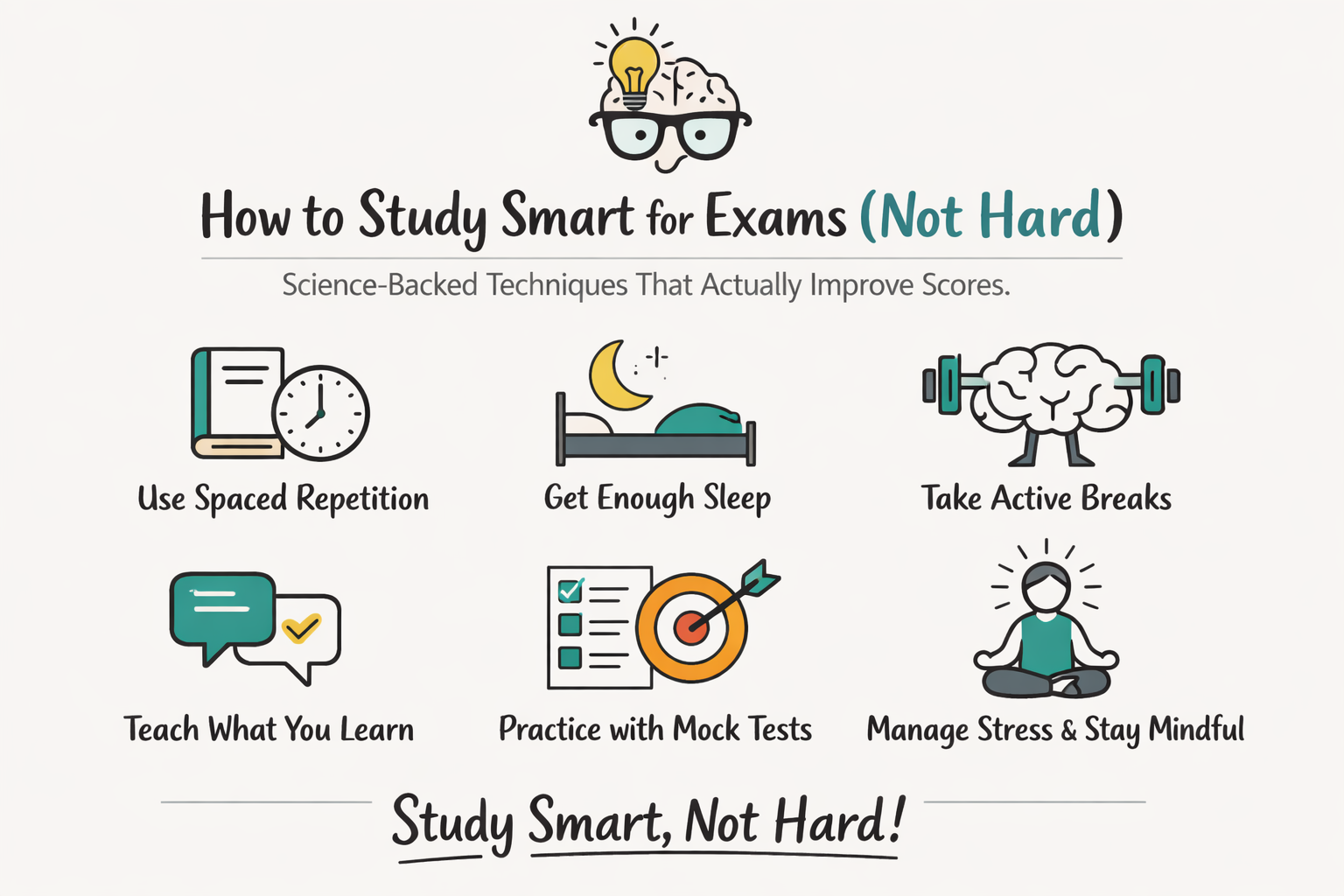
In the modern academic landscape, the "grind" is often glorified. However, cognitive science proves that long hours do not equate to high scores. Many students fall into the trap of "passive learning"—the act of reading and re-reading notes—which creates a false sense of security known as the fluency illusion.
To truly master your curriculum, you must transition from passive consumption to active cognitive engagement. Below are the most effective, research-backed strategies to optimize your brain for peak exam performance.
1. Active Recall: The Gold Standard of Learning
Active recall is the process of actively stimulating your memory for a piece of information. Instead of looking at a page, you force your brain to retrieve the data from within.
- The Science: Every time you retrieve a memory, it becomes more resistant to forgetting. A study published in Science found that students who used retrieval practice remembered 50% more of the material a week later than those who used traditional study methods.
- Implementation: After reading a section, close the book and write down everything you remember. Alternatively, use Anki or Quizlet to create flashcards that test your knowledge rather than just describing it.
2. Spaced Repetition: Defeating the Forgetting Curve
The human brain is designed to discard information it doesn't use. German psychologist Hermann Ebbinghaus discovered the "Forgetting Curve," which shows we lose nearly 70% of new information within 24 hours if it isn't reinforced.
- The Technique: Instead of "cramming" 10 hours in one day, study that topic for one hour across 10 days.
- Optimal Intervals: Review the material after:
- 24 Hours
- 3 Days
- 7 Days
- 14 Days
- 1 Month
3. The Feynman Technique: Simplify to Amplify
Named after Nobel Prize-winning physicist Richard Feynman, this technique identifies gaps in your understanding by forcing you to simplify complex ideas.
- The Process: 1. Choose a concept you are studying.
- 2. Teach it to a child: Explain the concept in plain, non-technical language as if you were talking to a 6-year-old.
- 3. Identify Gaps: When you get stuck or use "jargon" to hide a lack of understanding, go back to the source material.
- 4. Refine and Analogize: Create a simple analogy to describe the process.
4. Exam Psychology: Controlling the "Stress Response"
Even the best-prepared students can fail due to Exam Anxiety. High stress triggers the release of cortisol, which physically shuts down the neural pathways to the prefrontal cortex—the area of your brain responsible for logical reasoning and memory retrieval.
- The Fix: Use Interleaving. Instead of studying one subject for five hours (Block Practice), mix 2-3 subjects in one session. This mimics the "switching" your brain must do during an actual exam, reducing the shock of the test environment.
Summary Table: Smart vs. Hard Study Habits
| Feature | Hard Studying (Passive) | Smart Studying (Active) |
| Method | Re-reading, Highlighting | Active Recall, Blurting |
| Timing | Massed Practice (Cramming) | Spaced Repetition |
| Understanding | Memorizing Definitions | The Feynman Technique |
| Focus | Quantity of Hours | Quality of Retrieval |
Reference Links
- American Psychological Association (APA): The Benefits of Retrieval Practice
- Nature Journal: Spaced Repetition and Memory Consolidation
- Harvard University: The Science of Learning: Active Learning vs. Passive Learning
- Stanford Medicine: How Stress Affects Memory Retrieval