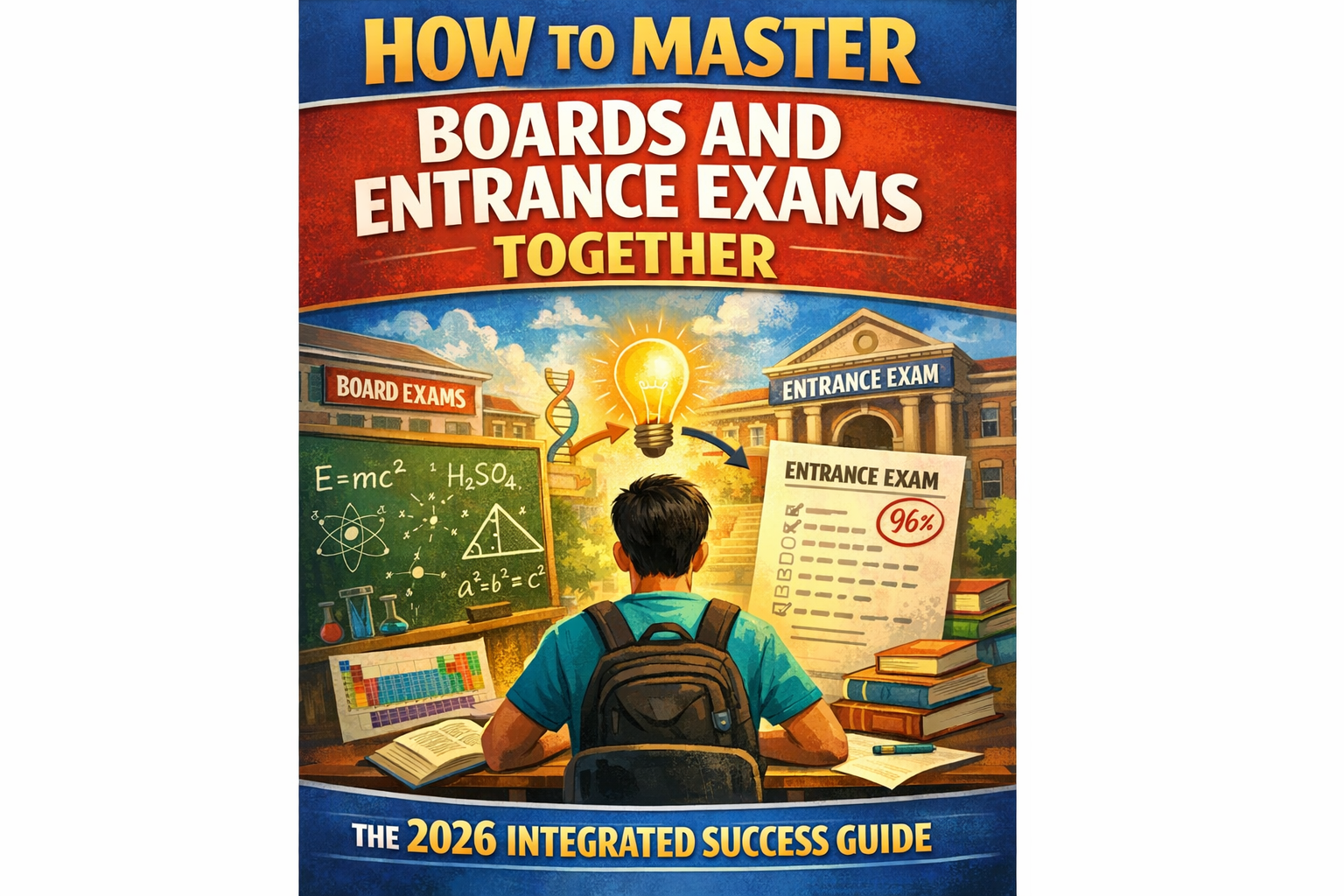
The Dual-Prep Manifesto: Synchronizing Boards & Entrances
For most students, the "Boards vs. Entrance" debate feels like a zero-sum game. If you focus on one, the other suffers. However, in 2026, the secret to success isn't choosing between them—it’s Integrated Learning.
Both exams usually draw from the same well: the NCERT syllabus. The only difference is the "output" format: Subjective (Boards) vs. Objective (Entrance).
1. The "Integrated" Strategy: One Effort, Two Results
Stop seeing your subjects as two different books. Instead, treat them as two different levels of the same game.
- NCERT as the Anchor: 90% of Board questions and nearly 70% of Entrance logic (especially in Chemistry and Biology) are derived from NCERT.
- The Layered Approach: 1. Read: Understand the NCERT theory (Boards).
- 2. Derive: Practice the long-form derivations or reaction mechanisms (Boards).
- 3. Apply: Immediately solve 30–50 MCQs on that specific topic (Entrance).
- The 70:30 Rule: Until December, spend 70% of your time on Entrance-level depth. From January onwards, flip it to 70% Board-specific presentation (writing, diagrams, and formatting).
2. Pro Tips & Underrated Gems
Pro Tips
- The "Subjective" Mock: Once a week, solve a 3-hour Board paper. Students often lose marks not because they don't know the answer, but because they can't manage time or presentation.
- Error Log Mastery: Maintain a notebook specifically for "Silly Mistakes" in MCQ mocks. Review this every Sunday night.
Underrated Tips (The 1% Margin)
- Optional Subjects are Gold: Don't ignore English or Physical Education. They are "percentage builders" that require only 2 hours on weekends to secure a 95+ score.
- Reverse Logic: When stuck on a complex Entrance numerical, try explaining the step-by-step logic aloud (Board style). If you can't verbalize it, you don't actually understand it.
- Diagrams are Free Marks: In Boards, a well-labeled diagram can get you 3/5 marks even if your theory is weak. Practice drawing these while you study for NEET/JEE.
What to Solve
| Resource Type | Recommended Material | Purpose |
| Foundation | NCERT Textbooks & Exemplars | Absolute basics for both exams. |
| Board Practice | Last 10 Years PYQs | Pattern recognition for recurring topics. |
| Entrance Practice | Coaching Modules / MTG Fingertips | Speed and application accuracy. |
| Revision | Personal Flashcards (Anki/Physical) | High-speed recall of formulas/reactions. |
- Organization: Notion for tracking syllabus completion across both formats.
- Focus: Forest App to block distractions during deep-work sessions.
- Revision: Anki for spaced repetition of Biology terms or Organic Chemistry reactions.
4. The "Hybrid" Study Planner (Sample Week for Your Reference)
This plan assumes you have school/classes during the day:
- Morning (6:00 AM – 8:00 AM): Entrance Focused. High-intensity MCQ practice or difficult numericals while your mind is fresh.
- Evening (5:00 PM – 8:00 PM): Deep Concept Work. Study a new chapter from NCERT; finish all back-exercises.
- Night (9:00 PM – 10:30 PM): Board Specific. Practice 2-3 long-form derivations, label 2 diagrams, or write an English essay.
- Sundays: The Simulation. Alternate weeks: One week for an Entrance Mock, the next for a Board Sample Paper.
5. Direct Reference Links
- NCERT Official Textbooks: Download PDF versions here
- CBSE Academic Resources: Syllabus & Sample Papers
- NTA Mock Test Portal: Official Practice for JEE/NEET/CUET
- National Digital Library of India: Free Academic Resources
