
Last updated on: February 27, 2026
67 Views
Yuvika Rathi
College Student
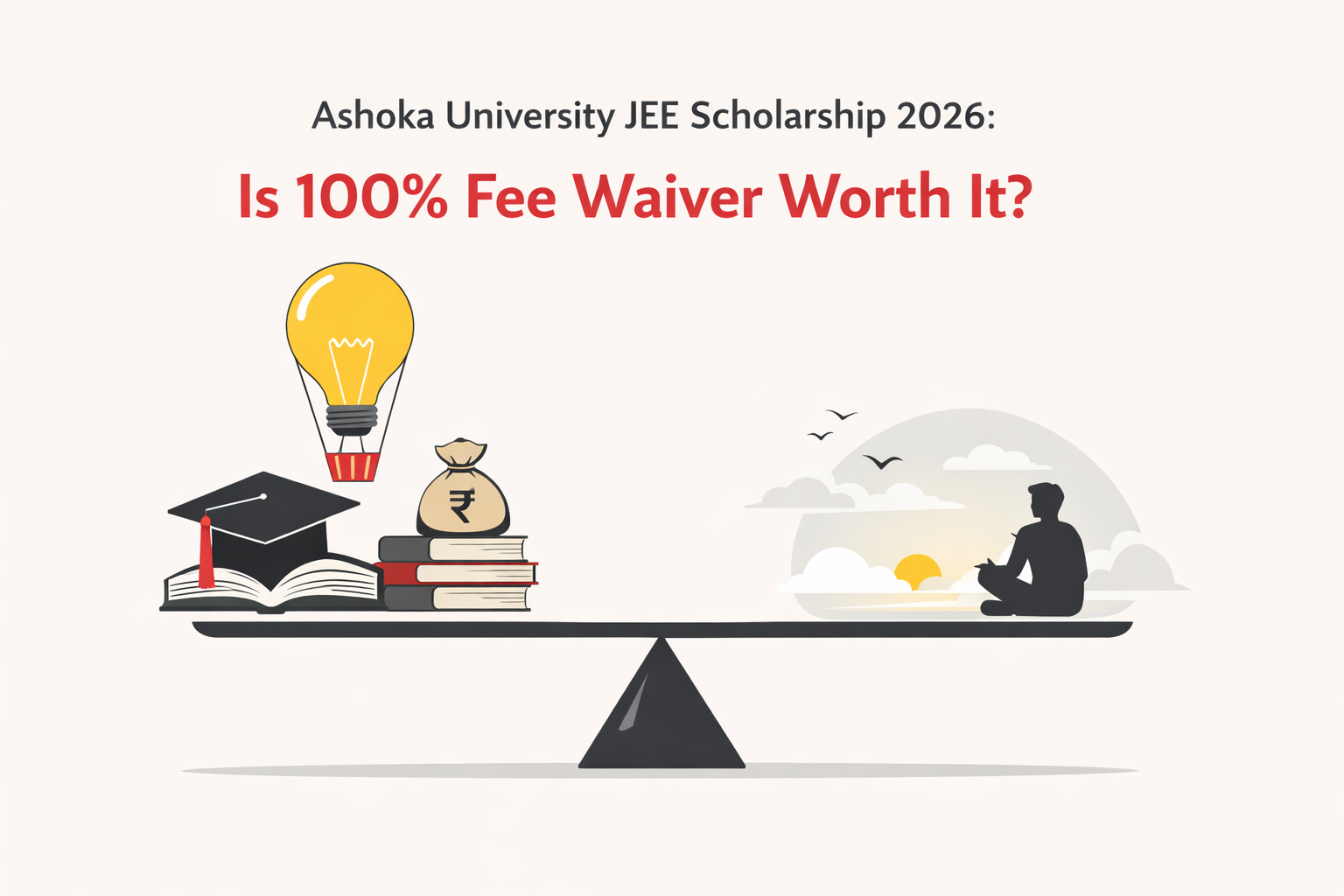
Ashoka University just announced 100% tuition fee waivers for 50 outstanding performers in JEE Main 2026. Students scoring minimum 98 percentile in JEE Main who meet Ashoka's admissions criteria become eligible for the Special Merit Scholarship under the undergraduate admissions 2026 cycle. Registration closes May 31, 2026.
For a JEE topper weighing options between IIT branches, NIT top colleges, or private engineering programs, this offer sounds tempting. But here's the catch Ashoka doesn't offer BTech. It offers Computer Science and Natural Sciences under a liberal arts framework. So the real question isn't whether the scholarship is good. It's whether liberal arts education at Ashoka is the right choice for someone who just cracked JEE.
Ashoka's official undergraduate fee for 2026 includes tuition of ten lakh twenty-two thousand rupees, residence costs of two lakh rupees, and essential services fees of five thousand four hundred rupees. Total annual cost: twelve lakh twenty-eight thousand six hundred fifty rupees. Over four years, that's forty-nine lakh fourteen thousand six hundred rupees.
The 100% fee waiver covers only tuition. It does not cover residence costs of two lakhs annually, dining costs minimum twenty thousand rupees annually, security deposits of seventy-five thousand rupees one-time, or acceptance fees of ten thousand rupees. So even with the full scholarship, you're paying roughly two lakh fifty thousand rupees annually, totaling ten lakhs over four years.
Compare this to IIT Delhi BTech where total annual cost including hostel is approximately two lakh fifty thousand rupees with no scholarship. Over four years, that's ten lakhs total cost. The financial difference between Ashoka with scholarship and IIT without scholarship is negligible. The real difference is what you're studying and how.
Ashoka follows an American-style liberal arts model. Students don't declare majors until the end of Year 1. The first year consists of foundation courses across humanities, sciences, and social sciences. You can major in Computer Science but must complete courses in philosophy, literature, economics, and history as mandatory core requirements.
For Computer Science specifically, Ashoka offers rigorous curriculum taught by faculty from leading Indian and global institutions. Class sizes are small, pedagogy is discussion-based, and research opportunities are accessible from Year 2. The university emphasizes critical thinking, interdisciplinary learning, and global citizenship alongside technical skills.
The disadvantage? Ashoka's Computer Science program is only seven years old. Its placement record, while improving, doesn't match IIT Delhi's legacy networks or alumni strength. Campus recruitment drives are smaller. Brand recognition in traditional engineering firms is limited compared to IITs.
Students who scored 98 percentile in JEE Main but didn't secure IIT seats often face a choice: take NIT lower branches, pay twenty to forty lakhs for private engineering colleges like VIT or Manipal, or explore alternative pathways. For this cohort, Ashoka's scholarship is transformative. They get world-class interdisciplinary education at effectively ten lakhs total cost over four years, comparable to NITs but with significantly smaller class sizes and personalized mentorship.
Students planning graduate school abroad particularly benefit. Ashoka has strong partnerships with global universities including University of Pennsylvania for a four-plus-one accelerated masters program. The liberal arts credential with strong GPA and research experience strengthens graduate school applications to US and European universities far more effectively than a mid-tier NIT BTech degree.
Students targeting product management, consulting, policy roles, or entrepreneurship benefit from Ashoka's interdisciplinary framework. These careers reward broad contextual thinking, communication skills, and cross-domain synthesis more than pure technical depth.
Students who secured IIT seats, even in lower branches or newer IITs, should take the IIT offer. The IIT tag, alumni network, and placement ecosystem remain unmatched. Core engineering roles at companies like Texas Instruments, Qualcomm, or traditional manufacturing firms heavily favor IIT graduates.
Students certain about pursuing traditional engineering careers in hardware, embedded systems, or core electronics should choose BTech programs at top NITs over Ashoka's Computer Science. Ashoka's strength is interdisciplinary breadth, not engineering depth.
Students whose families cannot afford the two lakh fifty thousand rupees annual non-tuition costs should carefully evaluate whether Ashoka's model justifies that expenditure compared to fully-funded IIT or heavily-subsidized NIT options.
Ashoka University is well-regarded in academia, consulting firms, NGOs, think tanks, and among graduate schools globally. It's less recognized in traditional Indian corporate engineering roles or among middle-class families unfamiliar with liberal arts education models.
A JEE topper choosing Ashoka over IIT Ropar or NIT Trichy will face questions from relatives, coaching teachers, and peers. The decision requires conviction that liberal arts education aligns with career goals and confidence to explain that choice repeatedly.
Ashoka University has committed seven hundred twenty-three crore rupees in need-based scholarships since inception, benefiting over five thousand four hundred students till now. Under the larger 2026 scholarships initiative, the university announced five hundred merit and need-based scholarships, including two hundred newly introduced merit scholarships. Beyond the fifty Special Merit Scholarships for JEE achievers, one hundred fifty Achievers' Merit Scholarships offer up to 100% tuition fee waivers based on holistic admissions performance and school board scores.
Uniquely, all awardees of Special Merit and Achievers' Merit Scholarships remain eligible for additional need-based assistance. This means if your family income is below eight lakhs annually, you can receive both merit scholarship and need-based aid, potentially covering residence and dining costs as well.
But here's what nobody mentions. The scholarship requires maintaining a CGPA of three point five or above each academic year. Drop below that threshold, you lose the scholarship. For students transitioning from coaching institute grind to discussion-based liberal arts pedagogy, maintaining three point five CGPA in subjects like philosophy and literature alongside Computer Science isn't automatic.
The Ashoka University 100% tuition fee waiver for JEE toppers is worth it if you're a ninety-eight percentile scorer who didn't get IIT, values interdisciplinary education, plans graduate school abroad, or targets non-traditional engineering careers like consulting or product management. It's not worth it if you secured IIT admission, want pure engineering depth, need fully-subsidized education, or aren't prepared to defend choosing liberal arts over traditional BTech to extended family and society.
The scholarship isn't a consolation prize. It's an alternative pathway. Whether it's the right pathway depends entirely on what you're optimizing for beyond just the JEE percentile.