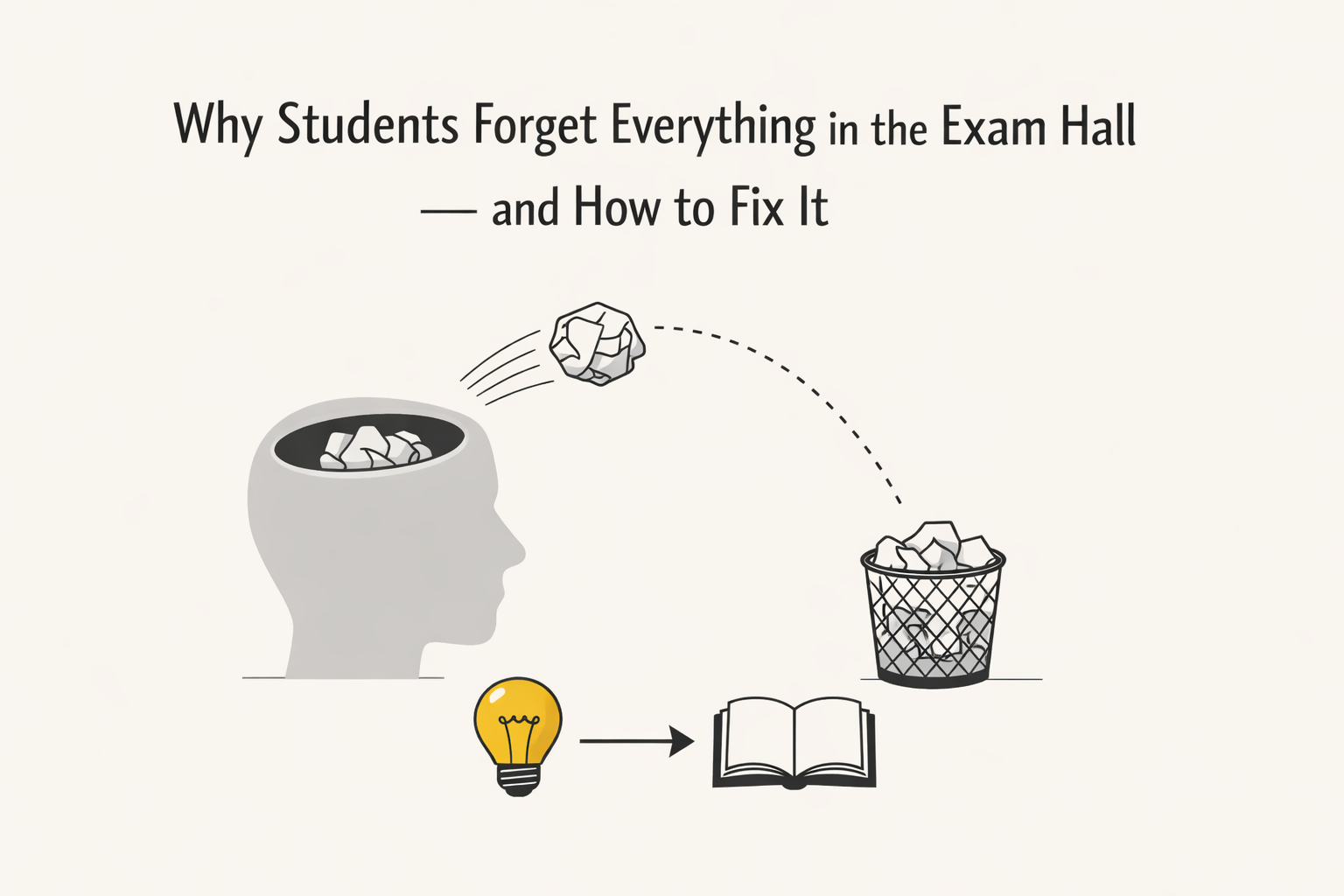
There is nothing more frustrating than spending weeks preparing for an exam, only to have your mind go completely blank the moment you see the question paper. This phenomenon, often called "Exam Hall Amnesia," is not a sign of low intelligence or poor preparation. It is a biological response to high-stakes pressure.
Understanding the neurobiology of memory failure is the first step toward mastering your "exam nerves" and ensuring your hard work translates into high scores.
1. The Science of the "Blank Out": Cortisol vs. Memory
When you feel threatened by a difficult exam paper, your body’s Sympathetic Nervous System kicks in, triggering the "fight or flight" response.
- The Cortisol Spike: Stress causes the adrenal glands to flood the system with cortisol. While a little cortisol improves focus, an excess physically inhibits the Hippocampus—the part of the brain responsible for memory retrieval.
- The Amygdala Hijack: Your brain's emotional center (the amygdala) takes over, diverting energy away from the Prefrontal Cortex (the rational, problem-solving center). Essentially, your brain prioritizes "survival" over "calculating the area of a circle."
2. State-Dependent Memory: The Secret to Reliable Recall
Psychological research suggests that we remember information best when we are in the same physical and emotional state as when we first learned it.
- The Mismatch: If you study while lying in a relaxed bed with music and coffee, but take the exam in a cold, silent room while sitting upright and stressed, your brain struggles to bridge the "context gap."
- The Fix: Mimic exam conditions. Study at a desk, in silence, and use the same stationery you intend to use during the test. This creates contextual cues that make retrieval effortless during the actual exam.
If you feel a panic attack or memory block coming on during the exam, use these science-backed "circuit breakers" to regain control:
- The 3-3-3 Breathing Technique: Inhale for 3 seconds, hold for 3, and exhale for 3. This stimulates the Vagus Nerve, which sends a signal to your brain that you are safe, manually lowering your heart rate and cortisol levels.
- The Brain Dump: As soon as the timer starts, spend two minutes writing down every formula, date, or mnemonic you are afraid of forgetting on your scratch paper. This clears your Working Memory, reducing cognitive load and anxiety for the rest of the paper.
- Reframe Anxiety as Excitement: Research from Harvard Business School shows that telling yourself "I am excited" rather than "I am calm" improves performance. Both emotions involve high physiological arousal; reframing it as excitement shifts your mindset from "threat" to "challenge."
| Feature | The "Panic" State | The "Flow" State |
| Dominant Hormone | High Cortisol & Adrenaline | Balanced Dopamine |
| Brain Region | Amygdala (Emotional) | Prefrontal Cortex (Rational) |
| Memory Access | Fragmented & Distorted | Fluid & Connected |
| Physical Symptom | Shallow breathing, racing heart | Controlled breathing, focused gaze |
The best way to prevent forgetting is to build "durable" memories. Use Interleaving (mixing different topics in one session) to force your brain to distinguish between similar concepts. When you practice "switching" during study, you train your brain to handle the unpredictable nature of exam questions.
Reference Links & Authority Sources
- Harvard University: The Science of Test Anxiety and Performance
- Psychology Today: Why We Black Out During Exams
- Johns Hopkins University: The Impact of Stress on Memory Retrieval
- Mayo Clinic: Mindfulness and Stress Management Techniques
