
Last updated on: January 3, 2026
65 Views
Yuvika Rathi
College Student
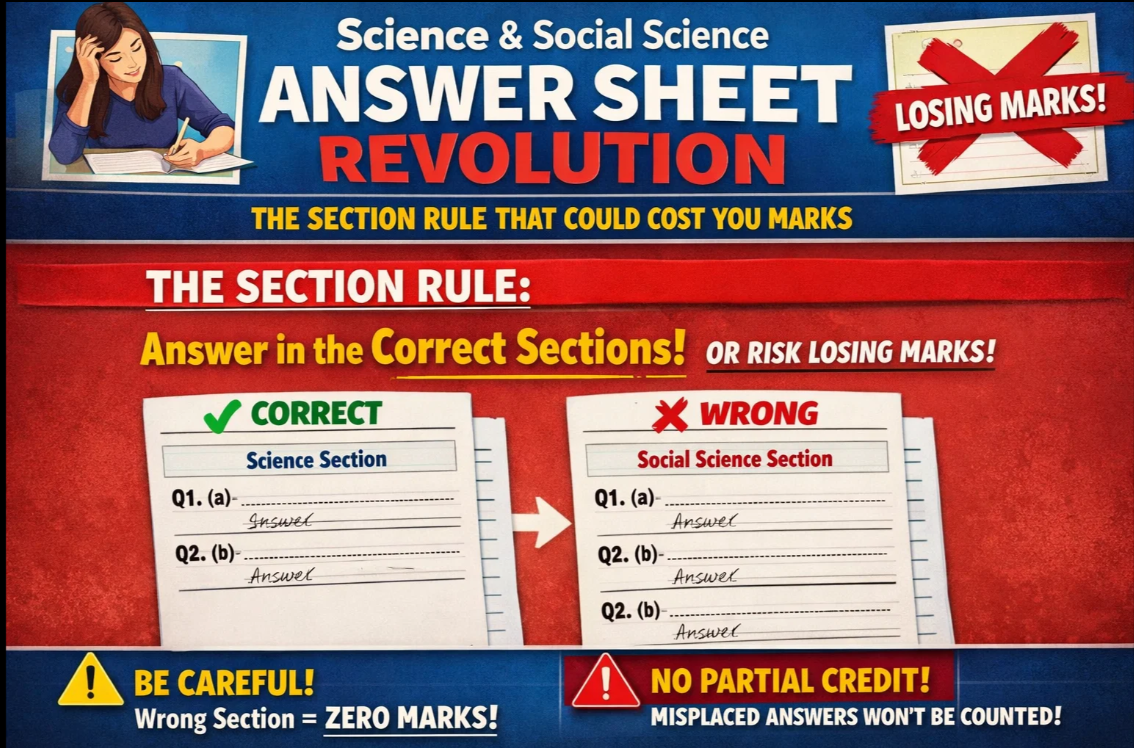
The CBSE just dropped a bomb on Class 10 students preparing for 2026 boards, and honestly, it's the kind of change that could make or break your score. Starting February 17, 2026, Science and Social Science answer sheets must follow a strict section-wise format—and CBSE isn't playing around. Write your Physics answer in the Biology section? Zero marks. Mix History with Geography? That answer won't even be checked. This isn't a suggestion; it's a hard rule that could cost you 20+ marks if you're not careful.
Here's what's new: CBSE has divided the Class 10 Science paper into three separate sections—Section A (Biology), Section B (Chemistry), and Section C (Physics). Similarly, the Social Science paper now has four distinct sections—Section A (History), Section B (Geography), Section C (Political Science), and Section D (Economics).
Before, questions from different subjects were mixed throughout the paper, and students could write answers anywhere in their answer booklet. That freedom is gone. Now, you must create these exact sections in your answer booklet before starting the exam and write each answer only in its designated space.
CBSE rolled out this change after years of examiners complaining that students mixed answers across subjects, making evaluation confusing and causing students to lose marks even when their content was correct. The board's solution? Mandatory structural compliance with zero tolerance for errors.
Sources: CBSE Official Guidelines | Career360 Analysis
This is where it gets serious. CBSE has explicitly stated that if you write an answer in the wrong section—even if the answer itself is 100% correct—it will not be evaluated. Not partially marked. Not given reduced marks. Not checked at all. Zero.
Even worse, these mistakes cannot be corrected during verification or re-evaluation. CBSE made this crystal clear: the section rule is final and absolute. There's no appeals process, no second chances, no "but I accidentally" excuses. The evaluator won't even read your brilliant answer if it's sitting in the wrong section.
Think about what this means practically. You could score 80/80 on your actual knowledge but end up with 60/80 because you carelessly wrote three 5-mark answers in incorrect sections. That's a 20-mark penalty—potentially the difference between 90% and 65%—not because you didn't know the material, but because you didn't follow the format.
Sources: Shiksha Education Report | ShikshanATION Guidelines
Before you start cursing CBSE, understand the reasoning. Examiners reported consistent difficulties in previous years when students wrote Biology answers mixed with Chemistry, or Economics explanations buried in the History section. This created evaluation chaos, delayed results, and caused legitimate marking errors.
The new section-wise format benefits students who follow it correctly:
The problem isn't the rule itself—it's that thousands of students don't know about it yet or aren't taking it seriously enough.
Source: SelfStudys Update
Here's exactly how to handle the new format without panicking:
Before writing a single word, create clearly labeled sections in your answer booklet. For Science, write "Section A - Biology," "Section B - Chemistry," and "Section C - Physics" with clear separations. For Social Science, label all four sections similarly.
Don't rush this step. Take 2-3 minutes at the start of your exam to set this up properly. It's worth far more than those three minutes of writing time.
Each question in the new format will clearly indicate which section it belongs to. Before writing any answer, verify you're writing in the matching section of your answer booklet. This sounds obvious, but in exam pressure, students frequently skip this check.
After finishing each answer, quickly verify: "Is this answer in the correct section?" Develop this habit now in practice tests so it becomes automatic during the actual exam.
If you run out of space in one section, ask for additional answer sheets specifically for that section. Do not continue that answer in a different section's space—even if you draw arrows or write notes saying "continued from Section A." CBSE won't accept it.
Use only the rough work pages provided. Don't do rough work in the middle of sections or in margins. Keep your answer sections clean and clearly organized.
Source: AMK Resource Info
CBSE has instructed all schools to incorporate this format into regular classroom tests, internal assessments, and pre-board examinations. If your school isn't doing this yet, take charge of your own preparation:
Download official sample papers from CBSE's academic website showing the new section-wise layout. These papers demonstrate exactly how questions will be structured.
Practice with timed mock tests using the section-wise format. Set up your answer sheets correctly at the start, then write under actual exam conditions. Do this at least 5-10 times before boards.
Ask teachers for feedback specifically on your answer sheet organization, not just content accuracy. Are your sections clearly labeled? Are answers staying within boundaries? Is your handwriting readable?
Simulate exam pressure: Have someone randomly inspect your practice answer sheets after completion to catch section errors you might have missed.
Sources: CBSE Materials Guide | Ecole Globale Resources
Here's the mindset change required: answering board exam questions is now a two-part skill. Part one is knowing the content (what you've always focused on). Part two is answering in the correct structural format (the new requirement).
You can't excel at just one and ignore the other. A student who knows 80% of the content but has perfect structural discipline will likely score higher than a student who knows 100% but carelessly violates section rules.
The evaluation scheme is final, and CBSE has made zero exceptions clear. This isn't negotiable, and complaining after results won't help. Your only option is to master the format before February 17, 2026.
Let's be brutally honest: this change will catch many students off guard. Some will lose 10-20 marks purely due to section errors, completely unrelated to their actual knowledge. Others will prepare properly and gain a competitive advantage over unprepared classmates.
The difference between these two groups won't be intelligence or study hours—it'll be awareness and practice. You now have that awareness. The question is whether you'll put in the practice.
Start today. Download the sample papers, practice section-wise answer writing in your next test, and develop the muscle memory needed to automatically check "Am I writing in the right section?" before every answer.
The CBSE Class 10 Board Exams 2026 start February 17, which gives you about two months to make this format second nature. That's plenty of time if you start now—and potentially not enough if you wait until January to take it seriously.