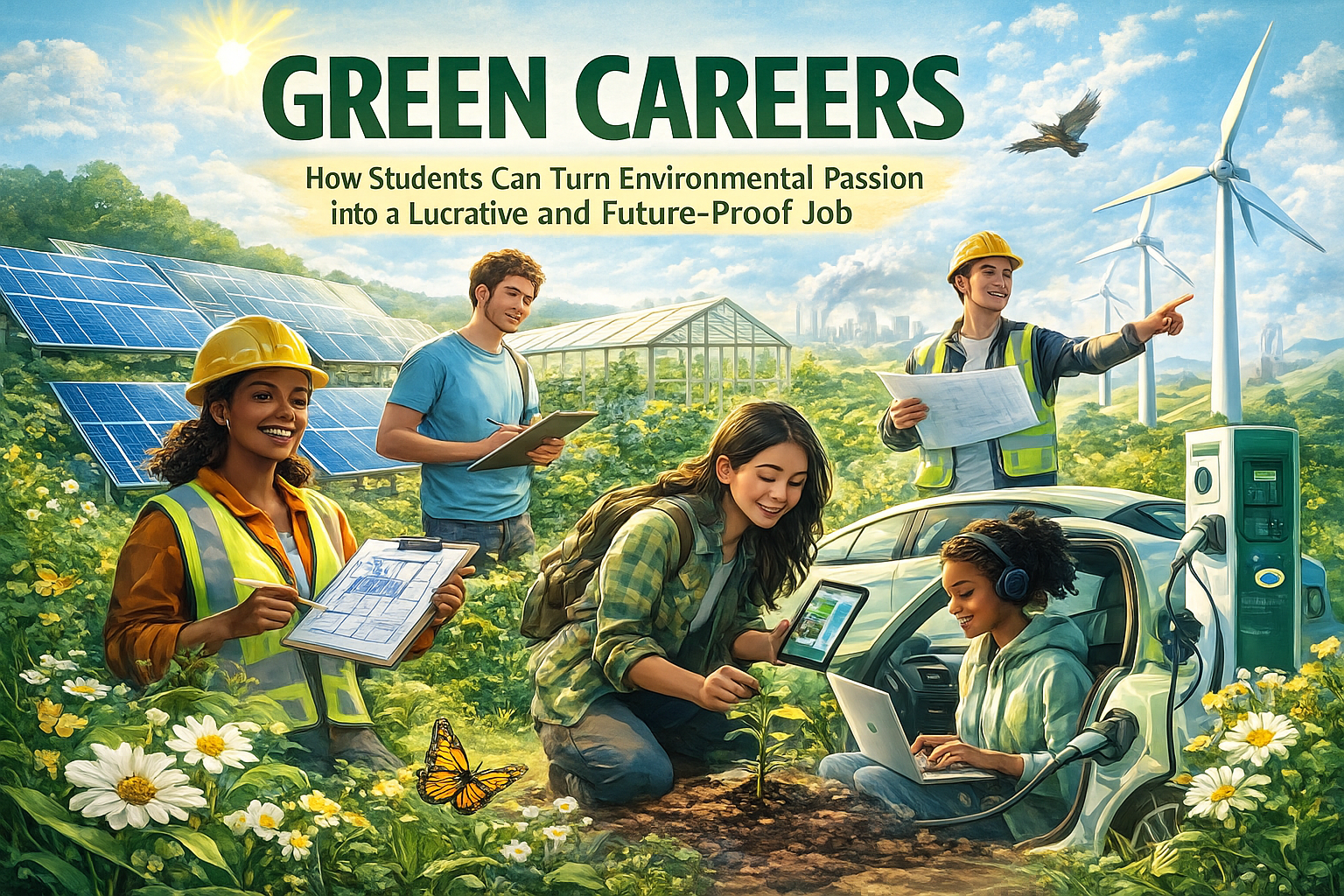
The global transition to a sustainable economy is not just an environmental imperative—it is the fastest-growing job market of the 21st century. Today’s environmental crisis is creating tomorrow’s most in-demand careers, often referred to as Green Jobs.
A green career is any role that contributes to preserving or restoring environmental quality, developing climate-friendly technology, or transitioning business practices toward sustainability. If you are passionate about the planet.
1. The Growth of the Green Economy: Why It Matters
Global investment in renewable energy, sustainable infrastructure, and circular economy initiatives is rapidly expanding. This boom is driving massive job growth across almost every sector:
- Fastest-Growing Jobs: The U.S. Bureau of Labor Statistics and other global forecasts predict that jobs like Wind Turbine Technician and Solar Photovoltaic Installer will be among the fastest-growing professions over the next decade.
- The Global Shift: The shift to renewables alone is expected to create millions of new jobs globally by 2030, according to the International Renewable Energy Agency (IRENA).
- The "Greening" of All Jobs: Even traditional roles in finance, law, engineering, and marketing are acquiring a "green layer," becoming ESG (Environmental, Social, and Governance) Analysts, Environmental Lawyers, or Sustainable Supply Chain Managers.
2. Three Major Pathways for a Green Career
Your passion for sustainability can align with virtually any academic or professional skill set. Green careers typically fall into three core categories:
| Pathway | Focus Area | Example Career Titles |
| I. Clean Technology & Engineering | Designing, building, and maintaining the infrastructure of the green economy. | Renewable Energy Engineer, Green Building Architect, Environmental Engineer, Electric Vehicle (EV) Specialist. |
| II. Policy, Advocacy, & Research | Changing the rules, regulations, and public understanding necessary for large-scale change. | Environmental Policy Analyst, Climate Change Analyst, Conservation Scientist, Environmental Educator, Urban Planner. |
| III. Business & Finance | Integrating sustainability into corporate strategy, investment, and operations. | Sustainability Consultant, ESG Analyst, Sustainable Supply Chain Coordinator, Environmental Accountant, Green Marketing Specialist. |
3. How to Start Building Your Green Résumé Now
You don't have to wait until graduation to begin your journey. Start cultivating the necessary green skills and experience today:
A. Interdisciplinary Education
- Mix and Match: The most effective sustainability professionals have diverse backgrounds. Pair your core major (e.g., Economics, Communication, or Chemistry) with a minor or certificate in Environmental Science, Sustainable Development, or Climate Policy.
- Learn Tech Skills: Master data analysis tools, GIS (Geographic Information Systems) mapping, and basic coding. The green economy is heavily reliant on Big Data and Analytical Thinking.
B. Gain Real-World Experience
- Internships: Seek out internships with certified B Corporations, local government planning departments, or environmental NGOs (Non-Governmental Organizations). This provides hands-on knowledge and networking opportunities.
- Volunteer Locally: Get involved with campus sustainability initiatives, local recycling programs, or community gardens. This demonstrates genuine commitment and soft skills like project management and communication.
C. Network and Connect
- Join Professional Bodies: Look for student chapters of organizations like the Association of Environmental Professionals or local climate action groups.
- Informational Interviews: Reach out to people with job titles that interest you (e.g., "Sustainability Manager at [Company]"). Ask them about their daily work and the skills they value most.
Conclusion: Your Role in the Future
The Green Economy offers more than just a job; it offers a career with purpose and profound impact. By combining your passion for the environment with strategic education and skill-building, you can position yourself at the forefront of this transformative field, ready to solve some of the world's most pressing challenges while securing a prosperous professional future.
References and Further Reading (With Direct Links)
- International Labour Organization (ILO): Green Jobs Report: https://www.ilo.org/global/topics/green-jobs/lang--en/index.htm
- (Note: This is a central resource on the global definition and growth of green employment.)
- University of Waterloo: Careers in the Environment, Sustainability, and Climate Change: https://uwaterloo.ca/future-students/missing-manual/careers/careers-environment-sustainability-and-climate-change
- (Provides detailed academic pathways and job titles.)
- The World Economic Forum: The Future of Jobs Report (Focusing on Green Transition): https://www.weforum.org/publications/the-future-of-jobs-report-2023/
- (Offers key data on the fastest-growing job clusters globally, including the green economy.)
- Green Careers Hub (IEMA): Let's Make All Jobs Greener: https://www.greencareershub.com/
- (An excellent resource for defining green skills and finding opportunities in various sectors.)