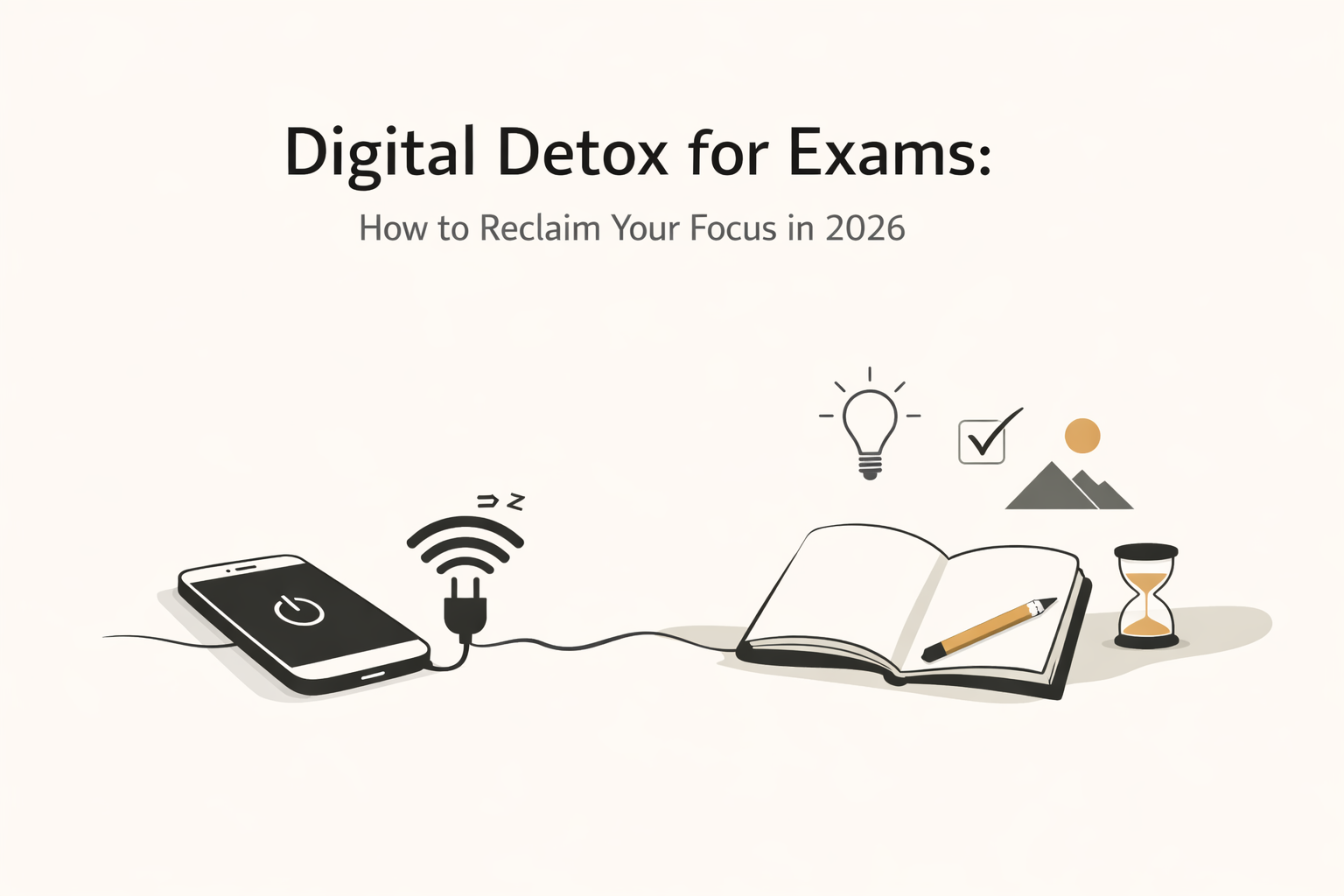
It’s 11 PM. You have three tabs of research open, a half-finished essay, and you just spent the last 45 minutes "taking a break" on Instagram. Sounds familiar?
In 2026, the biggest obstacle to passing your exams isn't a lack of information—it's Digital Burnout. When your brain is constantly hit with notifications and short-form videos, it loses its ability to "lock in" on complex topics.
Here is how to hit the reset button and build a "Focus Architecture" that actually works.
1. The 48-Hour Dopamine Fast
Before you start your heavy revision week, you need to lower your brain's "stimulation threshold." If you are used to constant excitement from gaming or scrolling, a textbook will feel impossibly boring.
- The Goal: Make "boring" tasks feel satisfying again.
- The Rule: For 48 hours, eliminate "High-Dopamine" triggers: social media, video games, and infinite scrolling.
- The Result: After two days of low stimulation, your brain becomes more sensitive to dopamine. Suddenly, finishing a chapter of history gives you a genuine sense of accomplishment.
2. Gray-Scale Your Phone
Your phone is designed to be a slot machine. The bright, vibrant colors of app icons are scientifically proven to trigger your "look at me" reflex.
- The Hack: Go into your phone’s Accessibility Settings and turn on Color Filters > Grayscale.
- Why it works: Instagram and YouTube look incredibly depressing in black and white. You’ll find yourself putting the phone down after 30 seconds because the "reward" of the visual color is gone.
3. "Exercise Snacking" for Mental Clarity
Recent 2025/2026 wellness research shows that long, grueling gym sessions during finals can actually increase stress hormones (cortisol). Instead, try Micro-Workouts.
- The Method: For every 90 minutes of study, do a 5-minute "snack."
- Examples: 20 jumping jacks, a quick sun salutation, or a walk around the block.
- The Benefit: This clears "brain fog" and resets your nervous system without the fatigue of a full workout.
4. Environment Design Beats Willpower
Stop trying to "resist" your phone. If it is in the same room as you, part of your brain is constantly using energy just to ignore it.
- The Solution: Use the Out of Sight, Out of Mind rule. Leave your phone in a completely different room—or better yet, give it to a friend or parent until your study block is over.
- Focus Apps: If you must use your device, use Forest (which plants virtual trees while you work) or Cold Turkey Blocker to lock yourself out of distracting websites.
Summary Checklist for Finals Week
| Habit | Action |
| Phone | Set to Grayscale + Leave in another room. |
| Breaks | 5-minute "movement snacks" instead of scrolling. |
| Sleep | No screens 30 mins before bed (Blue light kills memory consolidation). |
| Focus | Use a "dumb phone" app to simplify your home screen. |
Reference Section (Direct Links)
To learn more about the science of digital wellness and focus, check out these 2025-2026 resources:
- Digital Wellness Lab: 2025-26 Family & Student Digital Wellness Guide – Comprehensive advice on navigating AI and social media fatigue.
- Calm Blog: What is Dopamine Fasting? Benefits and How-To – A beginner-friendly guide to resetting your brain's reward system.
- The Times of India: Practical Strategies to Beat Digital Burnout – A 2025 report on how students can recharge their mental energy.
- MDPI Education Sciences: Digital and Psychological Well-Being Among Students – A 2025 study linking digital self-regulation to higher exam resilience.
- ASU Online: 10 Study Tips for Surviving Finals – Expert advice on "snacking on superfoods" and "snoozing social media."
