
Last updated on: February 27, 2026
176 Views
Yuvika Rathi
College Student
The University Grants Commission (UGC) Tuesday approved the guidelines for research internships that students can pursue at the undergraduate level. The National Education Policy (NEP) 2020 makes such internships mandatory and calls for research as a requirement for graduation in all domains, specifically for the four-year undergraduate programmes.
But here's what the official announcements aren't making clear: minimum 20 credits (approximately 320 hours) over the entire degree are required, with a maximum of 40 credits that can be earned via internships. And starting with the 2029 graduating batch, no internship credits equals degree withheld QS Quacquarelli Symonds. This isn't optional enrichment. It's a graduation requirement.
The internships of 8-10 weeks of 10 credits, after 2nd or 4th semester, will be mandatory for the students desirous of exiting with a certificate or Diploma, respectively. IBEF. For students completing a full four-year degree, the requirement is heavier — a minimum of 20 credits from internships spread across the program.
Research internship experience can be gained by working with faculty/scientists in education institutes, research institutions, industrial research labs, nationally reputed organisations and individual persons distinguished in specific fields. This means internships aren't limited to corporate offices. A music composition student can intern with a renowned composer. An architecture student can work with a practicing architect. A sociology student can assist with field research at a think tank.
But here's the catch: pure MOOCs (Coursera, edX) do NOT count; must have on-ground or virtual live mentor. Self-paced online courses, no matter how rigorous, won't fulfill this requirement.
The stipend floor is ₹8,000 per month for central universities; state universities are "encouraged" to match. But enforcement varies dramatically by institution type. Central and deemed universities have 100% stipend compliance funded by a ₹4,000 crore corpus (FY-26 budget). State universities have "stipend matching encouraged"; expect ₹4–6k in states like Bihar, UP; ₹8k+ in Maharashtra, Karnataka. QS Quacquarelli Symonds.
Translation: a student at JNU or Jamia is virtually guaranteed ₹8,000/month. A student at a state-affiliated college in Patna or Lucknow might get ₹4,000 — or might have to negotiate travel allowances instead of cash stipends. Private colleges can pool CSR funds but face no binding mandate.
An online portal has been developed where students can register themselves for research internships. Interns will be selected by host organisations based on their selection criteria. The official "Earn & Learn" portal — beta URL: internship.ugc.gov.in— goes live April 1, 2026. This is your one-stop platform for registration, offer letter uploads, credit tracking, and final evaluation.
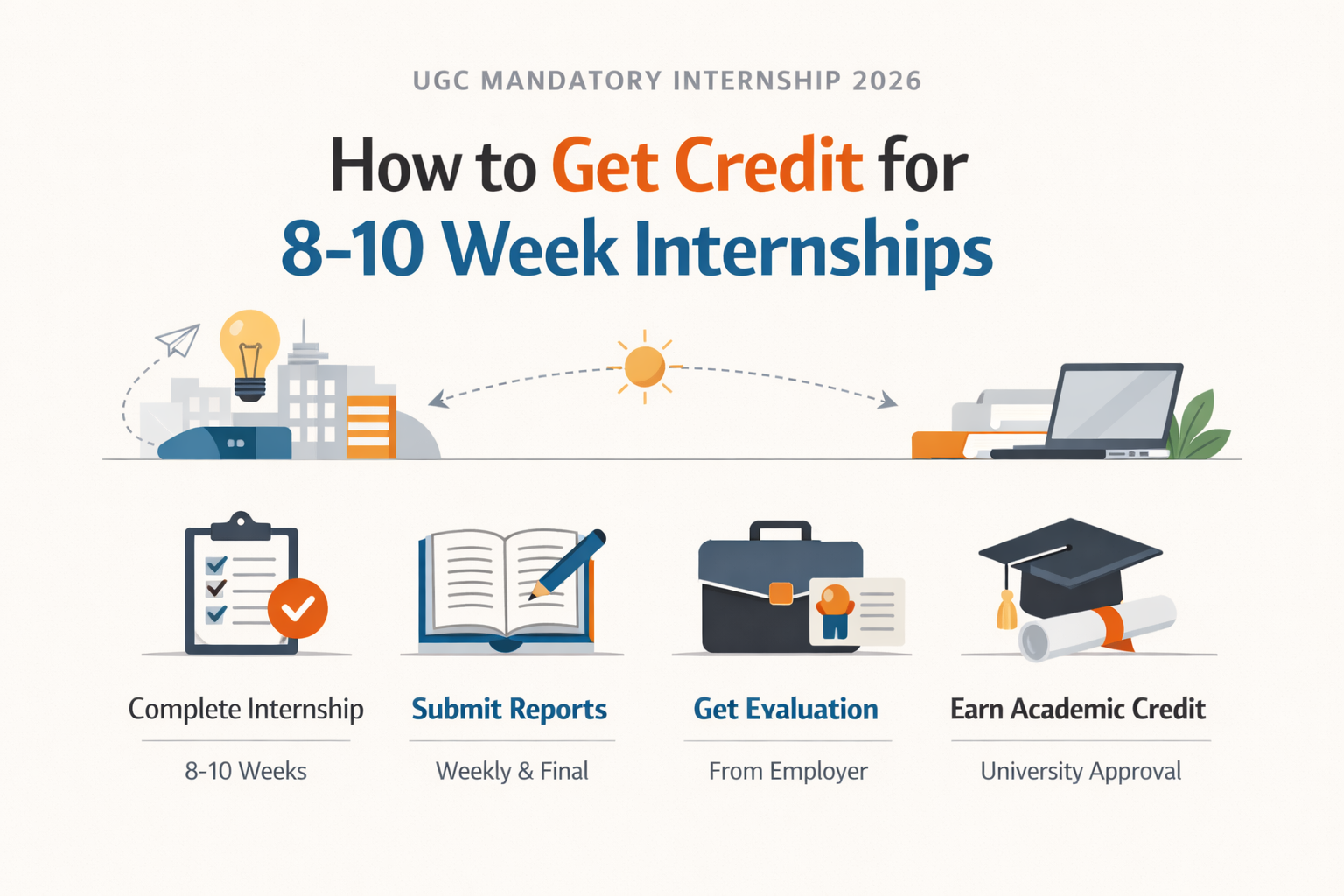
The workflow is structured: upload offer letter within 7 days of joining; submit mid-term report (1,000 words plus mentor sign-off) at 50% completion; submit final report plus presentation with viva by college panel requiring minimum 60% marks to pass. The portal auto-generates your credit transcript and sends it directly to the Academic Bank of Credits (ABC).
Student grievance goes to college internship cell (30-day resolve). Escalation goes to University grievance portal, then UGC's MAD (Mentor-Apprenticeship Dashboard). Non-compliant colleges face NAAC score downgrade plus reduced NEP autonomy grants.
This means colleges have institutional incentive to make sure you complete internships. It affects their accreditation, their funding, and their regulatory autonomy. Colleges will chase you to finish internships, not the other way round.
Myth 1: Internships will extend your degree duration. Fact: 20 core-course credits were removed — you finish in the same 3 or 4 years.
Myth 2: Only engineering students get paid. Fact: BA Programme English student at Hansraj bagged ₹12k/month at Times of India copy-edit desk in pilot batch. QS Quacquarelli Symonds.
Myth 3: Small-town colleges will have zero company access. Fact: UGC's portal aggregates opportunities nationally, and remote internships count if they have live mentorship.
The 8-10 week mandatory internship isn't a bureaucratic add-on. It's a structural redesign of Indian undergraduate education that treats work experience as academically equivalent to classroom learning. You graduate with credits, cash and contacts while your résumé says "experienced" before the first job interview. QS Quacquarelli Symonds. But only if you start planning now — the portal launches in six weeks, and the 2029 batch won't graduate without it.