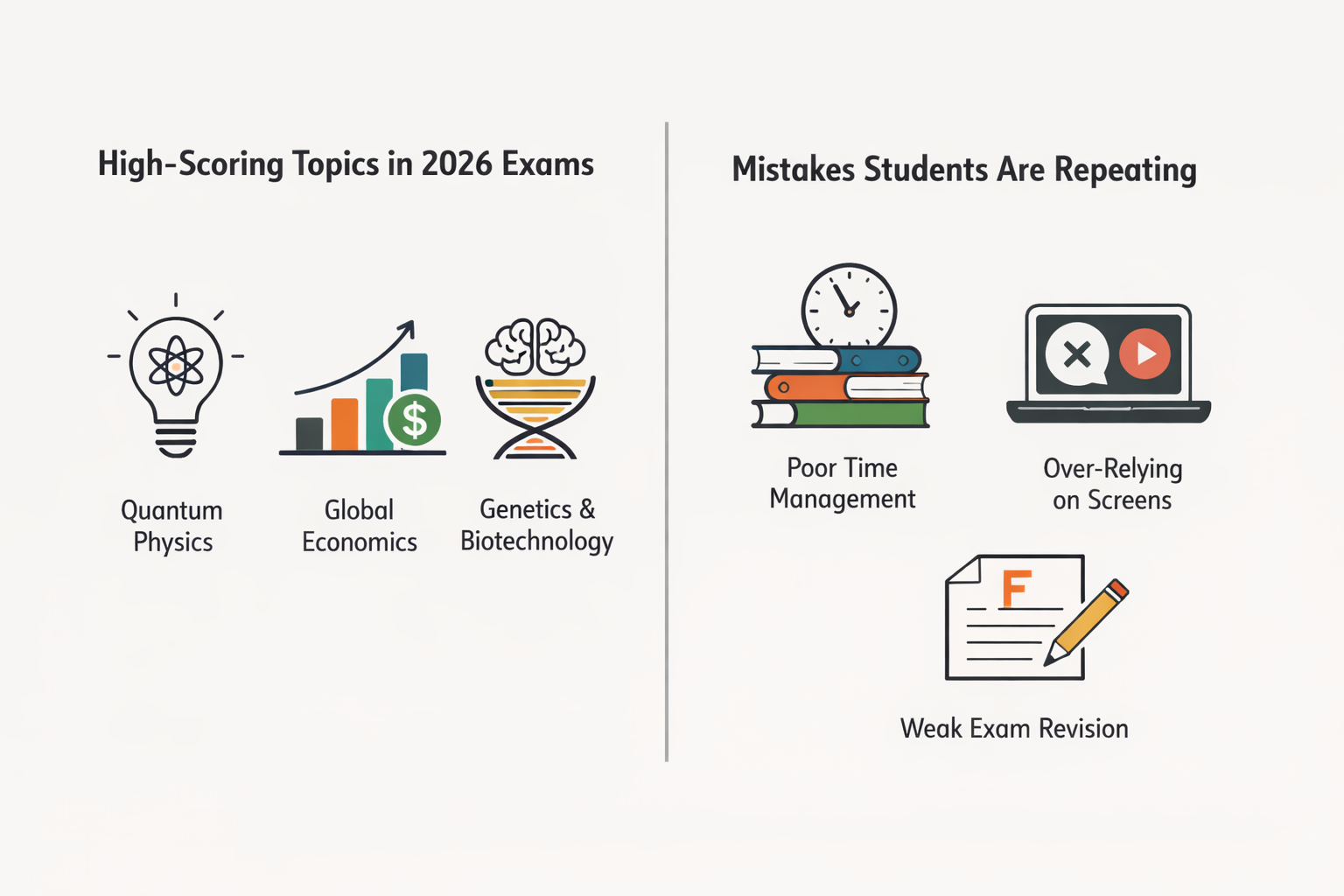
The 2026 examination season has revealed a shifting landscape in competitive testing. Based on the recent January sessions of major national exams like JEE Main, UPSC, and NEET, examiners are moving away from pure rote memorization and toward "time-trap" questions and interdisciplinary applications. Understanding these trends is the difference between a good score and a top rank.
1. High-Scoring Topics: Where the Marks Are
Recent papers show a heavy concentration of questions in specific "high-yield" zones. Mastering these is non-negotiable for 2026 aspirants.
| Subject/Stream | High-Weightage Topics (2026 Trend) | Nature of Questions |
| Mathematics | Vector 3D, Calculus (Integration/Differential), & Matrices | Lengthy, multi-step, and calculation-heavy. |
| Physics | Modern Physics, Ray Optics, & Thermodynamics | Formula-based but requiring conceptual "tweaks." |
| Chemistry | Organic Mechanisms & Statement-based Inorganic | Shift toward Assertion-Reasoning and NCERT theory. |
| General Apps | Logical Reasoning & Data Interpretation | Focus on "Inference" rather than direct facts. |
- The "Assertion-Reason" Surge: In 2026, Chemistry and Biology sections have seen an 18% increase in statement-based questions. Students who skip the "fine print" in NCERT textbooks are losing easy marks here.
- The Calculus Dominance: In recent engineering papers, Calculus and Vectors alone accounted for nearly 40% of the Mathematics section, often acting as the primary differentiator for high percentiles.
2. The "Time-Trap" Phenomenon: Common 2026 Mistakes
Analysis of the 2026 January papers suggests that students aren't failing because they don't know the material; they are failing because they are falling into time traps.
- The "First Question" Ego: Students are spending 5–8 minutes on the first difficult question they encounter. In 2026, examiners are intentionally placing "tough-but-solvable" problems at the start to drain student stamina.
- Neglecting the "Negative Marking" Strategy: Many freshers are chasing attempts instead of accuracy. For instance, in the latest JEE shifts, students attempting 70+ questions with 70% accuracy scored lower than those attempting 55 questions with 95% accuracy.
- Messy Rough Work: A surprising trend in 2026 is the rise in "silly errors" due to disorganized rough sheets. In calculation-heavy papers like Physics and Maths, messy handwriting is leading to misinterpreted digits in final steps.
3. Critical Strategy Adjustments for Upcoming Shifts
To avoid the pitfalls seen in the first half of 2026, adopt these high-structure habits:
- The 2-Cycle Approach: Go through the paper twice. Cycle 1 is for "low-hanging fruit" (direct theory/formula questions). Cycle 2 is for "the heavy lifters" (Calculus, complex mechanisms).
- NCERT is the Blueprint: For 2026, the trend of "Direct from NCERT" has returned with a vengeance, especially in Inorganic Chemistry and Biology.
- Active Error Logging: Don't just give mock tests; maintain an Error Book. Categorize every mistake as Conceptual, Calculation, or Time Pressure.
Pro-Tip: Recent 2026 toppers report spending 15% of their total study time purely on reviewing their own previous mistakes rather than learning new topics.
Reference Links
- JEE Main 2026 Shift-wise Analysis - Physics Wallah
- Common Mistakes in 2026 Competitive Exams - CareerIndia
- UPSC 2026 Preparation Guide - SPM IAS Academy
